



“The most important ally in the study of painting is the art of thinking,” stated Edgar Payne, famed artist and author.
One of my favorite books in my library is by Edgar Payne, “Composition of Outdoor Painting.” This little book is packed with a lifetime of knowledge from this famous American landscape painter. It is a must for every serious landscape painter.
I have learned that interpreting the landscape in paint is a matter of allowing the influences of imagination and emotions to guide you while keeping all artistic faculties alert. Artistic judgment and the fundamental principles of composition and selection should be respected while painting the landscape.
The concept of a successful landscape painting should have rhythm, variety, repetition, unity, balance and harmony.
The artist must rely on taste and judgement to select, delete and compose the landscape. Nature furnishes us with unlimited and sometimes overwhelming suggestions. It is the artist’s job to transpose the three dimensional landscape into a two dimension composition while making it believable.
The camera can aide in this task, however it should not be relied upon completely. Unfortunately, photographs lose much of the accurate color, depth and feeling that an artist can capture from life.
Many artists, including myself work from field studies otherwise known as plein air paintings as well as photographs. The camera serves as a recording tool and the field studies serve as reference material for accurate color notes and value judgements that are most often lost in photography.
The following list of things to ‘think’ about will help you make the most of your photographs:
composition
- horizon placement
- tree placement
- check out the ‘rule of thirds’
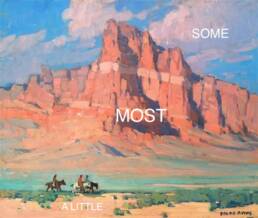
every good composition contains three or four main values
- one of these masses in the darkest
- one is the lightest
- the others are half tones with shading
- limited
- extended
- warm against cool
- opposite colors on the wheel
- feeling or passage of time
- brushwork
- tranquility or diversity
- emotionalism or realism
- mood
- atmospheric effects
- quiet or grandiose
I generally strive to create a poetic, simplified and elegant landscape. One that evokes a quiet contemplative mood that is easy on the eye and soul. Below are a few examples of how I used photography and then interpreted the landscape in paint.
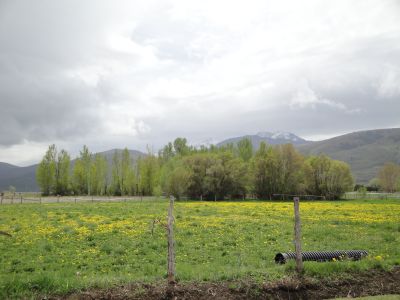
I took this photo while on a plein air painting trip in Utah.
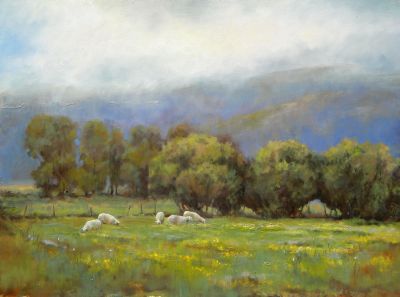
“Dandelions & Spring Rains” ©2010 Lori McNee
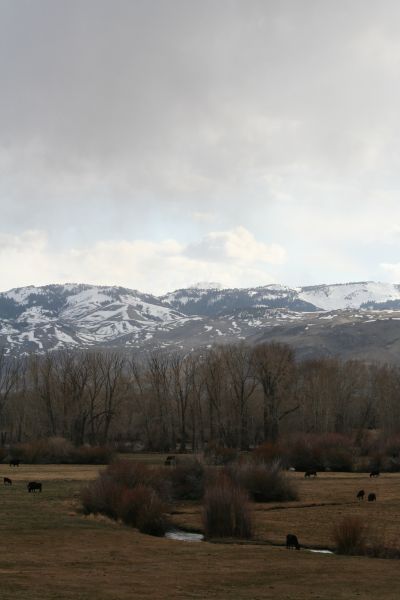
Photograph I took in central Idaho.
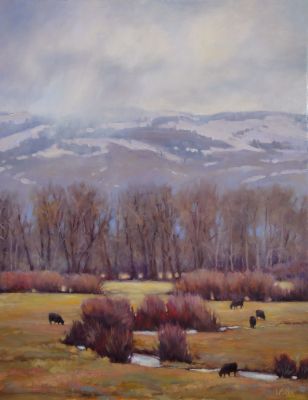
“Snow Flurries Above the Big Lost” ©2010 Lori McNee
I hope enjoyed seeing how I interpret the landscape. There are infinite ways and that’s what make us all unique as artists! Thanks for the visit, Lori
PS. Let’s meet on Twitter and Facebook!
Please take a moment to check out these other interesting articles:
How to Bring out the Mona Lisa in Your Own Artwork!
How to Use Good Reference Photos for Landscape Painting
A Favorite Book: Carlson’s Book of Landscape Painting
10 Motivating Tips fo the Plein Air Painter
Yellowstone Grizzly Bear Family: Too Close for Comfort!
How to Prepare Your Studio for Art Collector Visits
Tips for Selling Art on Facebook: A Success Story
7 Ways to Get Motivated in the Studio to Sell More Art

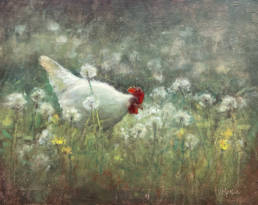
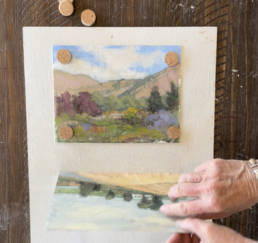
This is a really good explanation of the process! Thanks for sharing.
Thanks for stopping by and commenting. The process behind the art is always an intereting topic.
Lori 🙂
Since I’ve so enjoyed your blogging and videos, I thought it about time I told you so. This post with examples was especially important to me since I’m currently struggling with a photo/painting. Last week on another painting the process just sang. This week…nothing. I’ll eat lunch then trot out back to my studio to try again – this time with some McNee knowledge in my noggin!
Cher, comments like yours are why I am taking time away from my own painting in order to blog and share what I have learned with others…I am so glad this post helped you. We all get ‘stuck’ and during those times it is useful to find inspiration from others. Thanks for letting me know I helped!
Happy painting – Lori
Hi Lori- I really like your work. I am an art teacher and have recently started oil painting. I am taking lessons from a remarkable artist. Funny, we talked today about editing photos. I really like how you show examples of how you do that. I am finding I am relying too much on what I see in the photo and am not wanting to edit! But after seeing how you do that, I feel like I need to both take more photos and see what I already have inwaiting!
Hi Lisa, what a nice comment coming from an art teacher like yourself! I am so glad my ideas have helped you. That is why I am sharing my own tips in hopes of helping others. I have learned that Mother Nature gives us so much beauty, it is impossible to try and copy directly. Editing is a learned skill and it gets easier with practice. Just think about design!
Let me know how it goes!
Lori 🙂
Hi Lori.
This is a great post. The photos provide great examples of how to take a what nature provides and turn it into a beautiful piece of art. I think one of the more difficult things to learn for beginners is how to visualize a scene as a painting and how to createthat translation. I would love to see more photos/paintings that demonstrate this.