


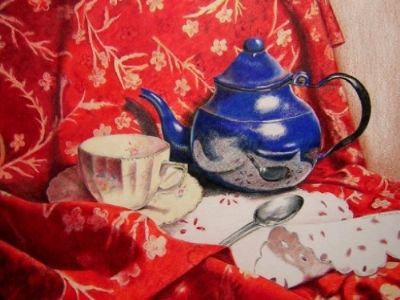
The use of colored pencil as an art form has been argued many times as to whether the medium should be considered painting or drawing.
According to The Merriam Webster Dictionary, the definition of paint is to apply color, pigment, or paint to…to produce in lines and colors on a surface by applying pigments.
The way the dictionary defines draw is to produce a likeness or representation of by making lines on a surface .
Whatever the verdict of the decision is in your eyes, I have enjoyed working with this medium for a number of years and the product of my art is truly satisfying.
There are many benefits of working with colored pencil. Colored pencil allows precision, control of detail and depth. You can work lightly for a soft look or with many layers get the effect of oil paint. Colored pencils are very easy to carry and you can work almost anywhere. There’s not a lot of prepping involved. It is an economical medium, and you don’t need many extra supplies. Colored pencil requires little space, no drying time and creates no fumes or chemicals – except for the fixative that’s used when your work is complete.
Here’s all you need to get
The Colored Pencil:
The pencil brand that I find to be the smoothest to work with is Prismacolor.
- This is a professional-grade pencils that can be blended, burnished and layered more than any other pencil I ve tried.
- The waxy buttery texture of the lead makes it ideal to blend color and create the perfect mix.
- www.prismacolor.com
The paper
- The right paper is very important, especially if you work in as many layers as I do.
- You can build 20 layers, or even more, which is very hard on your paper and can cause the surface to tear or buckle.
- I like Stonehenge fine art paper because it is 100% cotton and acid-free.
- The paper is buffered with calcium carbonate to help protect artwork from contaminated environments.
- Stonehenge is also sold in pads that come in a variety of sizes, but also comes in full 22 x 30 sheets so you can work large, (which is not easy in a time-consuming medium such as colored pencil) or cut it into any size you d like.
- I recently found out that they make a few colored pads as well.
- Depending on your subject, colored paper may be very helpful.
- It can give you a nice base color to start with, saving you lots of time and work!
- http://www.legionpaper.com/stonehenge/
- I have also worked directly on mat board.
- This is a good strong surface that is capable of taking erasure without going straight through your paper.
- Mat board comes in a wide array of colors and textures, but I most prefer a smooth surface to work on.
Erasers
- I prefer using kneeded erasers. Kneeded erasers are a gummy clay-like substance.
- Press the eraser on the area to be removed and lift it, which brings the color with it.
- Moving the eraser around like you would a regular eraser will just leave a smear.
- To clean this eraser, just pull and knead it like you would with a piece of dough.Colored pencil is not easy to remove completely but it can be done, except under certain circumstances.
- Colors such as certain shades of reds and blues seem to penetrate the paper and are harder to remove and lift the pencil wax rather than erasing.
- Electric or battery powered erasers are good; however, you have to be careful not to hold it in one place too long. This will go right through lightweight paper. It s best used on board or a heavier paper.
Pencil Sharpener
- Electrical or battery-operated are best.
- Get one that is sharp and gives the pencil a nice clean, smooth shaving. I like a sharp point because it allows me to get into the grain of the paper, but try different point sharpness and see what works best for you.
Colored pencils, a graphite pencil, paper/ board, eraser and sharpener – That’s all you need!
Now, here’s a quick colored pencil demo:
Step One: Begin with a pencil drawing. You can do this freehand or, until you feel comfortable, trace or transfer a picture with a lightbox/ transfer paper is available at your art or craft store.
Next, I put down my darker colors first, as an underpainting.
- You can use grays, browns or even try a color.
- An underpainting typically serves as a guide for subsequent layers of color.
Step Two: Blocking out a composition on the surface, the main shapes and tones of the picture are established. It helps to define values before being built up by layers of color. Often done in monochromatic color this process is also known as Grisaille.
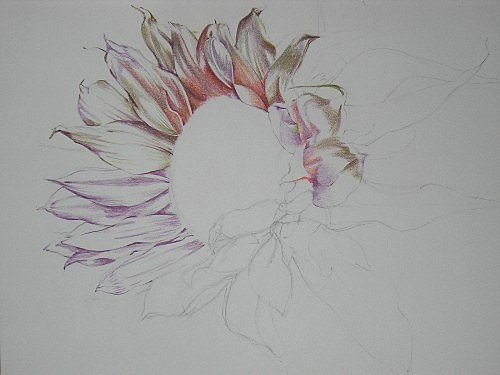
Step Three: I start adding color and layering as needed.
- Work right on top of your underpainting.
- This creates shadows under your color. You can blend colors as you add them.
- Prismacolor blends beautifully.
Step Four: Try adding the complimentary color which is the opposite the color that you are using, on the color wheel. You will be surprised at how this can add unexpected life to your artwork. Continue layering the colored pencil until you achieve the desired richness.
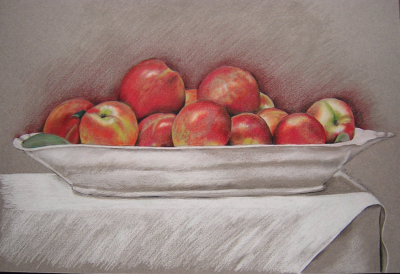
Start with something small like an apple and have fun experimenting with color and layering. You will love the versatility of colored pencil to create a wonderful work of art!
*****
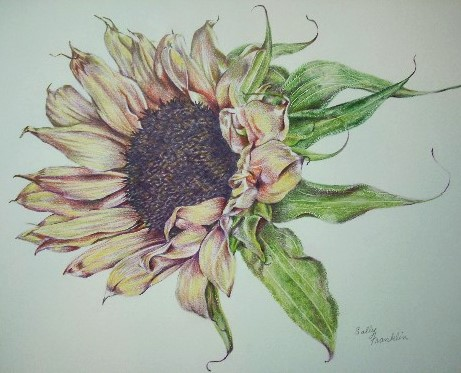
Guest Author/Artist: Sally Franklin was born in New York. She studied art at The Traphagen School of Fashion Design and Illustration in New York City, and from there began her professional art career as a fashion illustrator for a major department store. Sally is now focusing on fine art and although she enjoys many different mediums, much of her work is done in Prisma Colored Pencils. www.sallyfranklin.com
Let’s also meet on Twitter, and on Google Plus, Pinterest, and join in the fun at Fine Art Tips Facebook Fan Page! You might like to checkout my art at LoriMcNee.com, or find me on Instagram @lorimcneeartist.

I’ve recently subscribed to your blog and am really enjoying these tip sheets. I’m a full-time traveller and have been struggling with getting any painting done in the awkward amounts of time I have free on travel days. You’ve just given me my solution – colour pencils!
Hello Katherine. Thank you for sharing your thoughts with us. It is tough to find time to paint while traveling. In the past, I have used colored pencils from time to time while traveling and find them to be a lot of fun and liberating! They are so easy. I often use the watercolor pencils because I can bring one little brush and add a drop of water to the drawing and turn it into a painting! You might try that – then you can have the option of drawing with the pencils or adding some nice washes as well.
Let me know how it works for you…
~Lori
great post as usual!
Colored pencils truly have so many uses in the art world, and it’s nice to see them getting their due here.
I love pencils and colored pencils especially. I have used them in the past myself and have a big respect for them. What a challenging medium, but beautiful!
Thanks for the visit.
Lori
Thank for sharing your thoughts. I love colored pencils, but they are not as easy as they look!
Best-
Lori
Wow, that sunflower blows me away, what beautiful work! Coloured pencils are my current medium and I love mine dearly, but recently, Lori I’ve been unhappy with the way my art fades and the details aren’t coming out because of it and when one works possibly days on a picture, they don’t want their art to turn out like they worked on it in seconds, you know. Is it the paper I’m using ( printer paper )? The paper protectors? Or My pencils which are a mix from prismas to crayolas to off brands? The dreaded combination?
I’ve been thinking about just using acrylic paint to colour my art because colouring the details was half the fun.:'( If you can help me Lori I’d be honoured!
Monique, I use to draw with colored pencils many years ago. This was a guest post by artist, Sally Franklin. I do know that paper does make a big difference, so do the pencils. Some have more wax than others and it is best to stick with the same brand for consistency. I like to use bristol board and other drawing papers. You can also burnish the pencil colors, once they are all laid down for a rich look.
Acrylic paint might be a fun alternative for you to try. I love acrylics. They are easier to use and clean up. Remember, they do dry fast…but, you can correct mistakes by simple reapplying gesso of the area to be repainted. Let me know if this helped.
It was an honor having your comment!
Lori
I love drawing, I really like your painting style, specially your colored pencil paint. I wanna be like you, A Famous Artist. I don’t have website yet, maybe in the future i will, sorry about my bad english, i hope You understan what i said
Hello Karttika-
I do understand your English and really appreciate your sweet comment. Keep working at your art and eventually a website is a great idea! Thank you for visiting this website.
Best-
Lori 🙂
Hey Lori! I’m a teeneage in highschool and I’ve been wondering if you have any suggestions to becoming a great artist like you. If you have any suggestions also for improving my skills that would be very helpful, Thanks!
Hello Katie,
Thank you for the nice comment. Congrats on wanting to be an artist! It is a wonderful occupation and I wish you the best. My advice would be to study the works of great art that inspires you. Seek out instruction from qualified and talented artists. Practice your craft. Draw…and draw some more. All great art begins with good rendering skills. Learn about color. Study nature and follow your bliss.
I hope this helps!
Lori
Hello Lori and visitors,
I thought that I would post a follow up on my work.
I’ve been enjoying my colored pencils and have added watercolors to my
works. I’m looking forward to a solo show at “The Cup and Saucer Tea Room”, in Beacon, New York. They have their “Second Saturdays”, where they have a number of Galleries opening each month. What a fun Main Street to take a stroll on!
All the best,
Sally
Just wanted to comment on your professionalism. You are a great artist and conversationalist.
I am seventy one years young. I have worked with Prismacolor for years and found it very consistant in blending and true color. One question—I haven’t found a good way to do white whiskers on white paper except to form them with a grove first and color over them. Do you have any suggestions ? Thank you
Hello David, thanks for taking time to comment. I am glad you have enjoyed this blog. You can also try using frisket to mask the white area first. Let me know what you think!
Lori
Sally, your pencil drawing collections are fantastic. I am also an artist in Sri lanka specialty in conducting art classes for children. Kumarasiri Lelwala
Hello Kumarasiri,
I will let Sally know you have commented. Thanks so much. It is a pleasure to have a visitor all the way from Sri lanka! What a joy, teaching children.
Cheers,
Lori
Wow! I’m also here to comment you. I’m also like pencil and painting so much. And i am now about to come in this career.
Thanks !!!
I find that Winsor Newton “Derwenr” colored pencils work well on 2 ply Strathmore paper. I find that portraits are the most challenging. Building color on color must be done with a very light touch. Color can be removed from a good smooth stock with a razor blade, scraping very lightly.
Scraping lightly is key! Don’t want to tear the paper…the razor blade is a great tip. Thanks!
I started drawing with my kids’ pencil crayons last winter as a way to wind down after a day of computer work. I didn’t know if they could be considered true art. Actually, I also used marker on a few. I would blend them with an eraser or other tool.
I bought water colour pencils and tried them not so long ago, but was disappointed with the results. Maybe I’ll try both together. I also like oil but it’s messy and have done acrylic but get frustrated trying to blend it the same as I do oil.
Anyhow, I’m so thrilled to read this blog post and the recommendation for good supplies. Oddly enough, many of my first pictures were of sunflowers!
Hello Rosalie, I am happy to hear that this post has helped encourage you to continue with colored pencils. Funny about the sunflowers, but I can see why. That flower really lends itself to colored pencil techniques. Good luck and I hope you are happier with your next results.
Hi Lori, thanks for your inspiring works in color. I am an artist and educationist from Uganda- East Africa. I love your precision with colored pencil. I am eager to produce a lot of work in that medium.
I have enjoyed every bit of your blog.
Joab
Joab, I truly appreciate your feedback and apologize for the belated reply!
Hi I am new from RSA ! Please I need help if I do pencil drawing and I draw a picture now we start on color pencils over will you se the lines or must I make a copy then start with color pencils Thank you ” theo
Generally it is best to start with a light pencil drawing as a guide. The color will cover this. Good luck!
I am NOT a prisma fan, because of the wax buildup. I use polychromos colored pencils, and recommend those to anyone. Oh yeah, they are are very hard to break, and are almost completely lightfast!
Great feedback! We all have our personal favorites, don’t we? Thank goodness there are other brands…