


Have you ever thought about trying your hand at painting, or wondered if acrylics might be the right medium for you? Well, let me encourage you to pick up a paint brush and give them a try!
Here are a few reasons why:
- Acrylics are probably THE most versatile of paints.
- If you add water to them, you can achieve watercolor effects on paper, but with the permanence of acrylics or oils. (They do not lift off after they dry.)
- You can paint on many surfaces with acrylics – paper, canvas, metal, and wood, just to name a few.
- Acrylic paint dries very quickly, so unlike oils and watercolor, you do not have to wait before you can proceed further on your painting.
- If you want to slow down the drying time, you can add a medium called a ‘retarder’ and voila’! You have more time to work on getting the painting done just as you want before it dries.
- If you want to make your painting more like an oil painting, you can add different mediums to acrylic paint to make it thicker.
- There are also many different grounds and mediums to add to acrylics which give different textures.
- There is no limit to what you can do with acrylics!
Now that you have decided to try these paints, here are a few tips that will help you to fully enjoy this experience. Because this is not intended to be an e-book on painting with acrylics, but an article, I will only cover some of the tips I wish I had known when I began with acrylics.
USING THE PAINTS
- You can use a paper plate or an old dinner plate on which to squeeze out your paint.
- It helps to keep the paints pliable longer if you have a piece of dampened paper towel on the plate, and squeeze the paint onto it.
- Acrylic paint is somewhat thick and creamy as it comes out of the tube, so you must add a bit of water to it to make it a paintable consistency.
- Acrylics dry really fast once exposed to air. So, while you are painting, you need to spritz over the paints with water from an ordinary spray bottle to keep them moist without getting them too runny.
- You can keep your paints from one painting session to the next by covering the plate tightly with plastic wrap.
- The paint will stay moist until at least the next day.
- Once you are able to invest more in your artistic endeavors, I highly recommend that you purchase an acrylic palette, and “STA-WET” PALETTE PAPER SHEETS.

- These sheets will take your artistic life to a whole new level. One of my friends told me she just about wept when she discovered these sheets after painting for years without them! These sheets stay wet in your palette for weeks, and keep your paints fresh and moist for days and days. They really end up saving you money in the long-run.
PREPPING THE CANVAS
- Before you start painting, you will need to think about prepping your canvas. I suggest that you start by buying small, pre-primed canvasses. (As you become familiar with acrylics, you can buy unprimed canvas and gesso it yourself, if you wish.)
- It is always a good idea to lightly sand the canvas before you start, making sure to wipe it with a clean soft cloth after you have sanded it. Use a fine tooth piece of sanding paper rather than a coarse grade
- The next decision you will need to make is whether to paint directly onto the white gessoed hardboard/Masonite or canvas, or to prep the canvas with a neutral grey color. Some artists prep their canvases and boards with color – but I suggest you stick with either grey or white for now. I paint on both white canvas and a grayed canvas, depending on what I want my end result to be. The white canvas will give you a more bright and pure looking color tone, but it will take more paint to cover the canvas.
Can you tell which of these two flowers was painted on the greyed background?
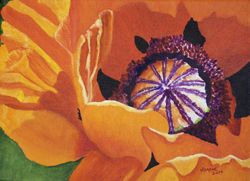
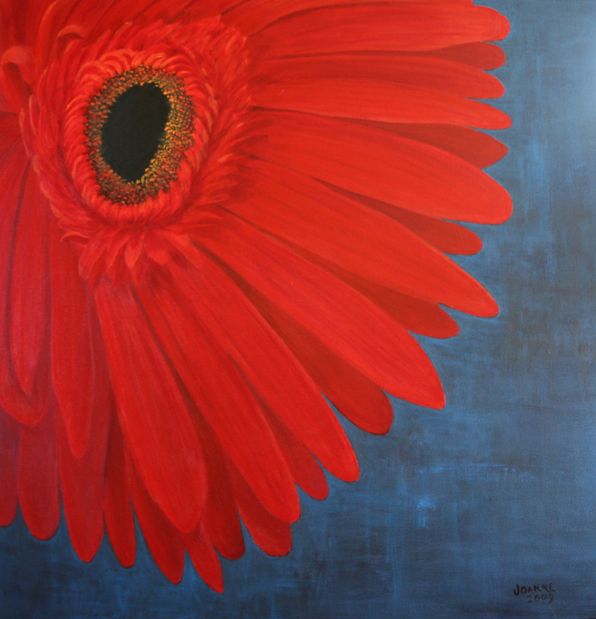
The red Gerbera Daisy painting was done on a canvas which had been prepped with grey paint, while I painted the orange Poppy interior directly onto white canvas!
-
To prep your canvas with grey, take some Mars Black (or any other black) and Titanium White, and mix the two until you achieve a medium grey color – about the color of the search engine bar at the top of this blog page. Once you have the paint mixed (mix up enough to cover the entire canvas at once), lightly spritz your canvas with water, and with your brush, smooth the water over the canvas so that the entire surface is lightly dampened. Then, cover your entire canvas (and sides) with the grey paint so that it is evenly covered. Allow the canvas to dry before the next step.
ADDING YOUR SKETCH
- You can add you sketch directly onto your canvas – either by tracing or freehand with a pencil.
- If you are tracing your sketch, first draw the sketch onto tracing paper which you have measured to be the same size as your canvas.
- Next, tape your tracing paper securely in place over the canvas, and slip a piece of WAX FREE transfer paper between the canvas and your sketch. I use Saral Transfer Paper.
- Go over the sketch lines lightly with a colored pencil so you will know where you have already traced.
- Check the canvas to make sure your lines are indeed transferring, but not too darkly.

PAINTING
- When painting with acrylics, you usually paint the mid tones first (local color), then add the darks (shadows), and finish with the lightest parts (highlights).
- One thing to be aware of and try to avoid when using acrylic paint is getting ‘hard edges’. This happens when you paint up to the edge of a line, and stop. When you come back to that same spot and want to blend the color, it is impossible because of the hard line which is formed when the paint dries so quickly. “Feather” your edges so that when you come back to that spot, you can easily blend or cover what is not desired in the painting. Feathering otherwise known as Sfumato is done by going over the drawn line with a very small amount of very thin paint – so that you can still see the drawn line underneath, but you do not have a definite hard line of paint built up at the edge of the drawn line.
- If you make a ‘mistake’ when painting, either try to wipe it off with a clean dampened rag, or wait until the paint has dried and paint over the mistake.
- If it is too difficult to paint over, you can always use Gesso (the white ground which is used to prime canvasses) to ‘white out’ the error, and start again – either on that patch or the entire painting!
BUYING ACRYLIC PAINTS
- You will find that acrylic paint is fairly inexpensive as far as paints go.
- Your local art store will have several brands of paint available, but if you would like to compare prices with online art stores, here are a few links where you can see most of the brands available.
- If you are on Twitteror Facebook, you can follow these stores, and take advantage of specials they offer regularly!
- If you can check out the manufacturer’s sites such as:
And there you have it! The mystery of painting successfully with acrylic paints explained! Visit your local library to find books on painting with acrylics to experiment and explore. As well, you can order books about painting with acrylics online or visit blogs such as the site you are now on FineArtTips.com!
Guest Artist/Author: Joanne Giesbrecht studied at the Alberta College of Art and Design in Canada, collected books, listened to the encouragement of other artists, and experimented. Now she creates professional color-saturated watercolors and acrylic paintings, focusing on simple subjects which fire her imagination. Email: jogiesbrecht@gmail.com
Top Paint Brush Tips from the Art Pros on Facebook
Watercolor Painting & Its Materials for the Beginner,
How to Make Your Own Inexpensive Small Painting Panels
How I Stopped a “Copycat Artist” on Facebook
Water Soluble Oils: Facts, Tips & Why I Use Them


Hi Lori,
My last posting just diisapeared, not sure what happened ……
I love artisans that can sell themselves! I’m not saying that to please you:-).
I would be very honoured if you would consider to publish some of your articles (we will do this for you) on our new Blog. Blog articles are randomly featured with individual listings by matching keywords. Every time you refresh the screen different articles will appear. Your articles will be presented with your lovely image and a link back to your blog.
Read more : http://www.krazart.com/blog/
To see what the effect is scroll down this page on our partner site (there are more blogs published, this site works in exact the same way, I would like to show you the principle): http://www.deligogo.com/showfood/1535/
We made made a small example of what “you” would look like in the blog: http://www.krazart.com/blog/252/0/ (can be removed in a second)
I would also like to offer you a free for life account in Krazart. No bills ever, no commissions. Free is free. we can set the account for you and add some examples, you don’t have to maintain the account, but you could if you wnated to:-).
Looking forward hearing from you,
Marcel – Krazart
http://www.krazart.com
marcel@krazart.com
Europe – The Netherlands
Thanks again for your comment and encouragement! I will be in touch. Lori
Hi Lori,
Thanks for a great article.
I especially like the example of the flowers, white gesso vs gray gesso.
If you want vivid color, I agree that it is ESSENTIAL to paint on top of white with acrylic to get the brightest color values.
I often re-paint white on top before adding new color to make it even more vibrant.
Looking forward to following your blog,
Cindy Davis, editor
Acrylic Paint Review
Hi Cindy, great to see you here on FineArtTips.com. I would welcome any tips that you might like to share with my readers and I appreciate you taking time to read and comment on the acrylic post.
Although I now primarily paint with oils, for years I painted with acrylics and really enjoyed using them. I also found that painting ontop of white gesso gave me the clearest, brightest colors and made my paintings glow.
Thanks for your sharing your tip.
Lori
Hello, for me underpainting gives a solid base to acrylic paintings. I never paint on white canvas, I tone it with a wash of blue if I want the painting to have a cool glow, such as a stormy rainy day, or with a wash of yellow, orange or yellow ochre, if I want the painting to have a warm glow. I find by color toning the canvas I don’t end up seeing white pinholes peeking through where I may use a drybrush scumbling technique. It really does make a difference in the end result for the way I paint, which is bright and bold. I also know a little secret to removing unwanted blob of dried acrylic paint.
Hi Teresa and thanks for sharing your personal acrylic tips with us. A simple underpainting has the power to really change the mood of the finished painting. I use underpaintings with my oils as well….
I would love you to share an article with FineArtTips where you can explain your scumbling and blob tip! Please let me know.
Thanks
~Lori
I would just like to suggest using a Tupperware bowl will finger painting paper as your palette and wet sponges or paper towels underneath it to keep it moist. Just put the cover on when you are done and your paint will remain moist for quite a while. The paper towel must be changed more often as it dries out, but it keeps the paint moist longer, even if you only had a thin layer of paint but need to keep it for later.
I haven’t tried the mentioned palette, but this tip can be an alternative 🙂
I always appreciate it when my readers share their tips and advice. Thanks Angela. A Tupperware bowl is a great idea for acrylics.
Happy painting-
Lori
Thanks for the tips; I am always looking for tips because I only paint once a year or so and I am planning my next painting soon!
Hello Heather,
Once a year? Do you paint a really involved piece of work, or is that all you have time to paint? Just curious. Good for you though! Thanks for sharing your comment and have fun painting.
Lori 🙂
Nice post, thank you. Can you tell me about the first paragraph more?
Thank you for the good writeup. It actually was a enjoyment account it. Look complex to far delivered agreeable from you! By the way, how can we keep in touch?
Thanks for the tips. I use acrylics and love them. Have you ever used orange to prime the board? And how dark of a gray do you use? I have seen gray pre-primed canvas before and wondered why they made them. Also I have seen black gesso. Have you used it and what is the effect?
Hi Mark, I have not used ‘orange’ to prime a board, but I do often use burnt sienna (kind of an orange) and sometimes even red. When I tone with a gray, I prefer a mid-value. It works best for measuring other values against it. Black is tricky. I strive to paint light, so I have not started with black – that might be a good challenge for me!
Thanks for the comment and visit-
Lori
Thanks Lori. Actually when I think of the black gesso it reminds me more of the black velvet paintings from the 60’s and 70’s. It might work good for a night painting though. I have never used orange for a base color either but am about to. I came across the idea from another artist. She told me that Rembrandt used the technique for his paintings.
I didn’t know that about Rembrandt…thanks for the info. Let me know how this works for you.
Cheers-
Lori
Hi Lori, I really like your site…so much information and really encouraging. I have been painting almost exclusively with acrylics for about a decade now and I love just about everything about them. My paintings are very detailed and that is easy with this medium. Another thing that is great about acrylics is the ability to glaze easily, since the layers dry so quickly. Acrylics are inherently translucent so the underlying colors influence the final result beautifully.
Hi Susan, I love all those attributes about acrylics too. I have just started to paint with them again after turing to oils. Now I am using both mediums and loving it!
My best-
Lori
I way prefer the medium of oils, haven’t turned back after doing a few paintings in acrylic which I find a bit too “plasticly” if that is an adequate descriptor. I do glazing as well, but since I use a thin layer of paint for glazing I don’t wait longer than a night for it to dry.
Although, Lori, don’t you find the lighter the colour tone the slower the paint dries.
Black dries so much faster.
I wander if there is a scientific reason for this: Like the colour white reflects light, so it would naturally take longer to dry….
Hello James,
Yes, lighter pigments often dry more slowly. But it’s really not a question of dark or light. Two light pigments, for instance, can be completely different chemicals, and that’s the main thing that influences the drying time. (The other main factor is whether or not the manufacturer adds anything to speed up the drying, which is sometimes done with the slowest-drying pigments.) Examples: Flake White is fast-drying; Alizarin Crimson (a dark color) is slow-drying.
If you need to speed up or slow down the drying, you can add special mediums to the paint…
Lori 🙂
Is there a difference in the brand that you use for painting, and does the more expensive paints have more boldness and brightness to them then the less expensive kind?
Hello Diana,
Student grade has less pigment, and saturation. I suggest using ‘artist grade’ paints whether using oil, watercolor or acrylic.
Thanks for stopping by,
Lori
Hi Lori,
Love your paintings and found your tips article very helpful. I have been looking for any tips or tricks in creating clean, curved outside border lines with acrylics. A lot of artists like heather brown, john culqui ( http://www.liquidsaltmag.com/2011/01/john-culqui/) do this. You probably do it all the time also.
Any suggestions in creating this effect?
Thanks so much!
Thank you! I usually make my own strokes with a flat brush. The good thing about acrylics is you can re-gesso an area over again if you are not happy with the results. You can also use a watercolor masking tool called frisket http://naturalpigments.com/detail.asp?PRODUCT_ID=612-WM4 . This allows you to mask out an area you don’t want to paint. Then you can remove the gummy frisket to reveal the unpainted area. I hope this helps.
Lori
hi Lori,
Love your blue background. I am a beginner. How do you get a different shades of tone on tone effect like you did w/ the blue?
thanks
Hello Debbie, that is not my painting…but, I do know how to paint with acrylics. Try using different blue pigments to get a variation of tone on tone. Ultramarine blue, cobalt, cerulean, are a few suggestions. Good luck!
Hi Lori,
I am a beginner and was am having trouble finding where could I get sketches to put on a canvas and paint? Have any ideas?
Thanks,
Brooke
Sketches are best if they are your own. You can draw with a pencil or charcoal directly to the canvas, then add paint. Using your photographs for inspiration will help. Have fun!
Just found your sight Lori, and there are so many good tips. My mother was an artist but I lost her when she was only 55 in a car accident. I started painting cow skulls just because I love cowboy art, and I found them easy to paint on, then my sister-in-law asked me to paint a 6×6 canvas for her art guild. I found it very different and much more difficult to paint on canvas, but now that I have your tips about, sanding ore pre-primed canvas and painting the canvas first, I am thrilled. I would like to be able to make tiny fine lines, and it is very difficult to do, but perhaps it will be easier if I prep the canvas like you say, but do you have any tips for that. I don’t want straight lines, I just need to be able to be able to make them very fine with detail. Thanks, Dawn Anita
Hello Dawn, it is great to hear that you found my site and tips helpful. You might also like to try painting on gesso board. However, you can add more gesso to the canvas and sand in between the layers to get a smoother surface. Does that help you? ~Lori
Hi Lori, I did buy some Golden Gesso and have painted 3 coats on my 6 x 6 canvas. I did not sand in between, so I think I will sand it lightly and put another coat on before I start to paint. I’m anxious to see how it works when I start painting. I’m hoping that it will help with fine lines and detail. Thanks, Dawn Anita
Hi Lori,
I am working with canson and acrylic… I want to make a single color background as even as possible before start my work… I tried using a roller but it got grainy… any suggestions?
Cheers!
Marcelo
I’ve used a roller before, but it leaves a dappled texture. You might want to try using a few, very thin layers of acrylic. Allow it to dry in between coats. Use a very soft brush with light handed strokes. I have done this in the past and it works. Good luck!
Lori, I love and appreciate your website and I find your tips and remarks extremely useful! The comments of other artists are also helpful. I can hardly stop reading!!!
Thank you for sharing your experience with the rest of the world:)
I wish I could paint like you some day:)
Thank you!
Hello Ewa! I am embarrassed to be so behind on replying to comments. I truly appreciate your feedback and hope you are still enjoying my blog. I love helping others like you! Life has been extra busy for me and I hope to see you here again. ~Lori 🙂
My experience with acrylic paint has been dismal. The color changing when drying added to the short time allowance make it a very limiting painting experience. No time for large gradients applied with brush, false contrast effects from application time to final drying time, and inconsistent saturation values from color to color. These are a few of the reasons I consider acrylics a very inadequate medium, especially for the beginner painter. These limitations will hinder the learning curve of the budding artist and limit the “tricks” that can be discovered as with oil paints. Starting to paint with acrylics as a learning medium will more than likely hinder the development of a painter and the exploration of the painting discipline. Acrylics are adequate for a number of specific applications, but to really delve on the limitless experience that painting offers, oils should be the primary medium. Let’s not even mention the care and clean up attention that has to be dedicated to the brushes themselves, so they will not be ruined after a 5 minute work pause.
Very respectfully, Miguel osuna
Hello Miguel, thank you for your thoughtful comment. My apologies for the belated reply!
Anyway, I was an acrylic painter for many years, and became proficient at using them. They have a benefit, but I do enjoy painting with oils now. Like you, I find limitations with acrylics. I still use them as an underpainting sometimes. I do like how quickly they dry!
I painted with oils for years before switching to acrylics because they dry so much faster. I loved the way I could blend lights and darks with oils but after not painting for a number of years I find it difficult to know whether to paint light colors first and then the gradually darker shades or the other way around. Right now I am trying to paint flower petals and I’m having a difficult time figuring out what to do. Can you offer any advice please.
Hi Leslie, thanks for reaching out to me for advice. Generally speaking, with acrylic and oil painting we paint dark to light – then slowly layer lighter values as the painting builds. However, acrylic paints are more forgiving. You can paint light over dark if the underpainting is dry. It will take more layers of light paint to cover the dark passages though. So, try and keep to the dark to light formula! Happy painting! ~Lori
Hi, I just found your site! I need help so badly in the acrylic layering technique. I paint abstracts – in neutral colors…and no matter how hard I try, and I’m on the 6th layer mind you, can I see anything but one layer below of whatever color of Mali is the last one. No finesse. I don’t – can’t get it! Help! I think I need an acrylic art class! Anyway, thanks for all your information. I did get lots from this post! Lots!tt
My apologies for the belated reply Judy. I hope by now you have taken some art classes and have found the answers. If not, hopefully my post has helped. Thanks!