


We have all been taught that ‘oil and water do not mix’ so, how can oil paints possibly be water-mixable?
The answer is this: “On a molecular level, the oil vehicle has been modified to make it mixable in water, eliminating the necessity for turpentine or other dangerous solvents to thin paint and clean brushes and other supplies.”
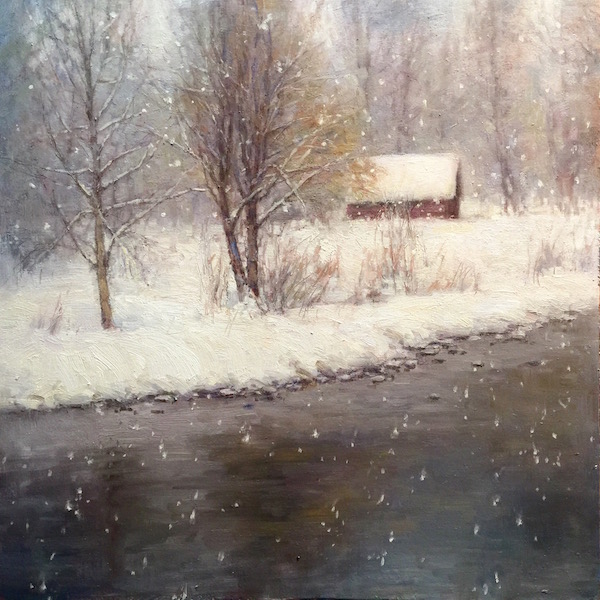
First of all, water-mixable oils are REAL oils. They are water-mixable and are not water-based. There are still some painting purists who question whether or not these pigments are true oils, but I assure you they are.
Artist’s grade, water-mixable oil brands have the working properties of true oil paint. They are REAL oil paints made with a linseed oil binder.
In fact, I have been successfully executing my paintings using water-mixable oils with professional results since the 1990s.
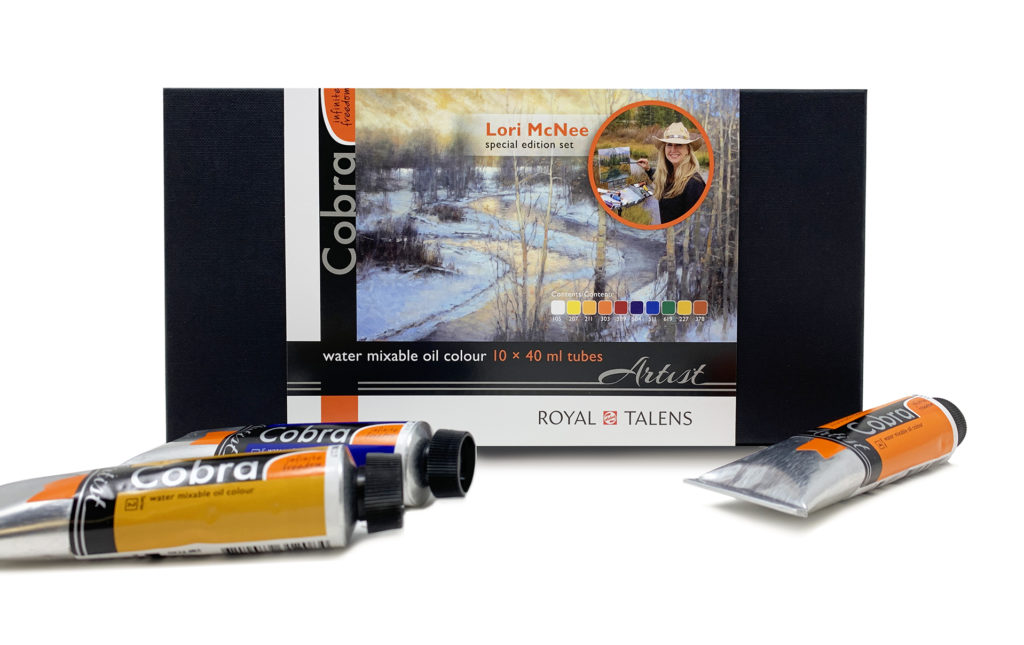
I made the smooth transition from acrylics to the new oils in my home studio so my family and pets were not exposed to toxic fumes. My favorite brand is Cobra by Royal Talens. Cobra Artist Oils are completely archival, with lightfast pigments and a durable linseed oil binder. Cobra Artists colors have a comparable pigment load to other traditional oils in their class.
With an open mind and a little experimenting, you might also enjoy the benefits of water-mixable oils. Below, I will do my best to inform you of this remarkable paint medium from my own personal experience and with a little help from the technically informative book, “Painting with Water Soluble Oils,” by Sean Dye. (*Although these paints are NOT water-soluble, they ARE water-mixable!)
Facts:
- Water-mixable oils are also known as solvent-free or water-miscible oil paints. These oil paints offer greater convenience and increased accessibility. These new oils are especially helpful for people with allergies, home studios, students, schools, and those who have avoided oils because of the toxic solvents.
- Water-mixable oils smell great. Some brands have a milder scent than others.
- Water-mixable oils are made with linseed oil, just like traditional oil paints.
- These water-miscible oils were developed to be used with water in place of turpentine, mineral spirits, or other solvents!
- The vegetable drying oils have been restructured in water-mixable oils which helps to eliminate yellowing.
- Like traditional oils, water-mixable oils must dry through oxidation – absorbing oxygen through the air. Once dry, they are just like any other oil painting and should be treated as such.
- Like traditional oils, water-mixable oil paintings cannot be reactivated with water when dry.
- Most water-mixable brands have mediums that have been developed for water-mixable oils: quick dry mediums (my favorite), stand oils, painting mediums and impasto mediums, linseed oils, and alkyd mediums.
- Traditional oil paints and mediums can be added to the new oils in small amounts of up to 20%-30% and still retain water mixability. Small amounts of traditional oil color can be added to the water-mixable oils without affecting the color or consistency.
- The new pigments blend and mix extremely well.
- When water-mixable oils are mixed with water, they may at times appear somewhat cloudy until the water evaporates.
- The fast-drying mediums allow for plenty of time for blending but still make over-painting easier and faster.
- Luminous, transparent glazes can be made by using water-mixable mediums. Rich, opaque darks are easy to achieve.
- Water-mixable paints produce fresh, bright, strong colors. It is easier to avoid making a ‘muddy’ color.
- Water mixable-oils are easier to clean up – with only soap and water!
- Those with limited or no experience with traditional oils adjust to water-mixable oils more quickly.
- Depending on how thick you paint, the water-mixable oils retain their elasticity and workability for up to 48 hours.

Tips:
- Water-mixable oil paints are perfect for travel, especially on airplanes. Many airlines restrict traditional and flammable solvents on commercial flights. Eliminating the need for harsh solvents makes water-mixable oils easy to pack for painting on location whether by car, plane, or horseback.
- The plein air painter can keep paint on the palette for long periods of time without the paint drying out.
- Take care when drying freshly painted new oil or traditional oil paintings. Avoid dark or moist areas to prevent darkening or yellowing that is caused by the linseed oil.
- Acrylic gesso should be used as the starting ground for water-mixable paints to ensure proper adhesion.
- Synthetic paintbrushes are best for painting with water-mixable oil paints. But natural bristles are good for underpaintings but do not let them sit in water or they become mushy.
- A few drops of linseed oil on the palette restore the paints to their original workable form.
- All oil paint should be applied fat over lean to prevent cracking.
- Do NOT mix water-mixable oil paints with acrylic paints. Oils and Acrylics dry very differently and mixing them will compromise the long-term integrity of the paint film.
- Use water to thin the paint and for laying in washes. Build up the oily layers after the underpainting is dry.
- Just like with traditional oils, water-mixable oil paints can be laid down in many smooth, thin layers – called indirect painting. Also water-mixable oils can be applied in a thick wet single layer called direct or alla prima painting or everything else in between.
- Drying time is longer when a lot of white pigment is used.
- The dark passages in water-mixable oils sometimes ‘sink’ and lack the glossy appearance of a traditional oil painting. This is easily remedied by a final varnish.
- I prefer Cobra solvent-free oil paints by Royal Talens. The characteristics of this brand are consistent with their traditional oil-color counterparts. They use all of the traditional pigments in their lines including cadmium and cobalt. These paints deliver brilliant, luminous transparent glazes and rich opaque passages.
- Water-mixable oils clean-up with soap and water. However, Terpenoid Natural can be used on hard-to-clean brushes. Baby oil is also a good cleaner, followed by soap and water.
- Use a little petroleum jelly conditions the brushes back to their original shape.
- Rubbing Alcohol, white vinegar, or vegetable oil and a razor blade are great for cleaning a glass palette for the next painting session.
Hopefully, you now have a better understanding and appreciation for the benefits of water mixable oils. They are easier and less intimidating to use and deliver the beautiful results of traditional oils.
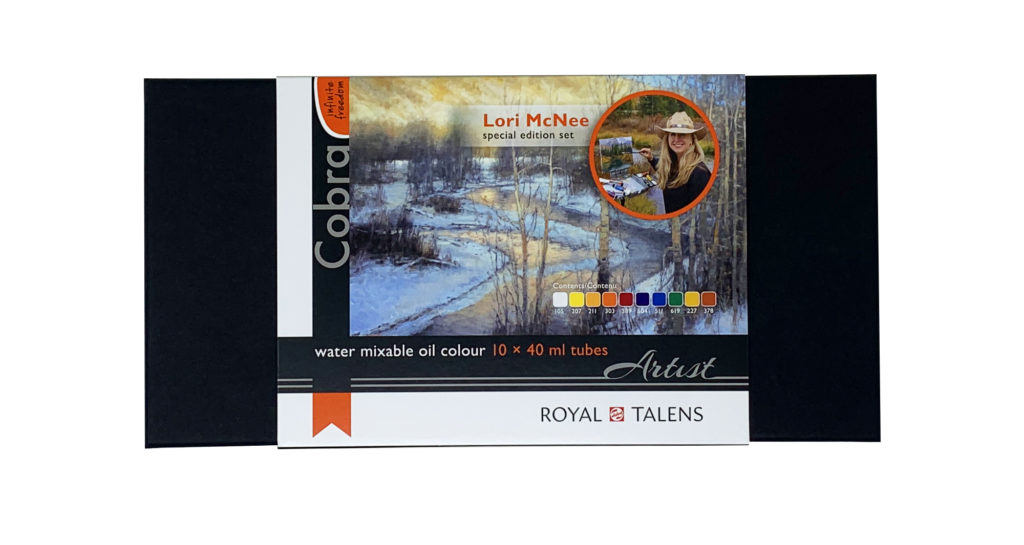
You might enjoy trying my new Cobra Oil “Lori McNee Special Edition Set.”



Great post Lori! I’ve never tried these paints, but it might be time for me to make the switch. Are the water-solubles much more expensive than the regular oils?
Absolutely agree with you Lori, I use the Artisan brand in all my oil paintings, with the Artisan Linseed Oil for thinning my paints. Also, I read this in a magazine – I can’t lay claim to the idea, you can mix them with water to create some wonderful watercolour paintings, but in oil!
I also use canvas paper as it’s cheaper than buying box canvas and is much easier to frame when fully dry.
And the tip of using a glass palette is also great, I used to use a wooden palette but the paint never truly comes off it, ALL paint easily scrapes off glass with a razor blade.
Keep up the good work Lori!
Ronnie, please accept my apologies for the delayed reply. I truly appreciate your thoughtful comment and hope you are enjoying the tips you have learned. Please visit again soon. Lori 🙂
I also changed from acrylics to water soluble oils, but I’ve now moved on to proper oils, which I find have a better feel than water solubles. It is hard to describe but they are just more luscious to paint with INMHO
totally agree – oils are a different thing all together…especially blending!
Thanks for sharing your thoughts…
Thanks for sharing your thoughts on oils with us. I am glad you are happy with traditional oils…they are obviously wonderful to use. Lori 🙂
Hi, I’ve created a forum for artist who paint with water soluble oils and it would be great if you could come and have a look : http://watersolubleoils.forumotion.com
Hi Janet- I have been traveling for a few weeks and just returned. I plan to check out your forum this week. Thanks for the invitation and for visiting my site. Lori
I’ve only ever painted with Acrylics, since oil paint intimidates me. I’ve been thinking about trying out water-mixable oils and this article has been a great resource. Thanks!
As I mentioned in the article, I painted with acrylics for years. I love water-mixable oils and encourage you to try them. Let me know how they work for you, Claire. 🙂
Lori, Read your article on watermixable oils on the Empty Easel site. I’ve been trying out the Artisan Windsor Newton brand paints a few times over this past year. Worked on canvas as well as 2 coats of acrylic gesso on paper. My one disappointment is that they have a sticky/plastic feel and look to them after they’re dry. I admit that I haven’t invested in the brands varnishes…would that solve the problem?
I live in Santa Fe and other artists here have had a similar complaint.
Do have any suggestions.
Thank you for sharing your knowledge and time.
Raya
Hi Raya, I am catching up on comments. I apologize for the delay… I have not had that problem and I live in dry Idaho. It sounds like you might not be using a medium with your paints. I use the Quick Dry medium and find it gives my paints a rich feel. Try using a medium with your paints after you lay in the underpainting with water. Reduse the water from that point on. Then you can varnish with Liquin by Winsor & Newton when the paint is dry to the touch. This might help, but let me know! Thanks for taking time to read and comment on the article. Good luck – Lori
Hi there,
I was wondering if it is okay to finish a half-finished traditional oil painting with water mixable oils on top. Would that cause any cracking? I really hope not because I love these paints and I really don’t have proper ventilation for using turpentine.
Thanks!
Yes you can use water soluble oils ontop of tradition oils. Is the painting dry already??? If not, you can use the new oils just like any other oil with mediums…do not add water at this point except to rinse out brushes. If your painting is already dry, I suggest adding a layer of ‘retouch varnish’ before you paint with water soluble oils…then again, do not use water at this point, only mediums. I hope this helps! Let me know how it goes for you and we can share a post about it here…please keep in touch! Lori 🙂
Another through and informed article Lori. Thanks. I got some black and white water solubles so I can practice painting just in gray scale and snag a couple of minutes’ painting time without the big clean up.
However, this particular black paint happens to smell like asphalt. One is tempted to don a hard hat in the studio.
Karia, I just noticed that I never responded to you comment! I agree with you about the scent of black paint. It isn’t my favorite fragrance either! Being an artist isn’t for sissies – lol. Thanks for the visit and I hope to see you again someday.
Lori
Which of the paintings shown on your website are done with water-soluble oils? Your work is truly amazing, like Vermeer! What brand of water-soluble oils do you prefer? Thank you!
Hi Meisha – thanks for the nice words about my work! I only use water-soluble oil paints, so all the paintings you see displayed are of that medium. I use either Artisan, Grumbacher or Van Gogh…which ever brand is easy to get my hands when I am at a store. They all work well, but Van Gogh might be the creamiest – however their paint names are different, so that throws me off a bit. I have used Artisan and Grumbacher the most.
Hope that helps. Thanks for the comment!
Lori 🙂
Hi Lori. I just bought my first set of these yesterday, so I was very glad to find your site this morning. I’m a pastelist and mixed media artist and have never tried oils of any kind… and it’s been a while since I have even done any pastels. So, I’m excited to try these! Thanks.
Dianne, I think you will really enjoy these paints. Of course, as with any new media, there is a learning curve…
Keep in touch and let us know how they work for you!
Best-
Lori
Hi Lori, Love your informative site, and thank you so much for the generous information you share with your fellow painters. I, too, am a water soluble oil painter and have just posted a bunch of tips on my site here: http://www.artforthesoulofit.com/2011/02/03/why-i-use-water-soluble-oils/
My goal is to not only be a solvent-free oil painter, but also toxic-free (eliminating cadmiums and cobalts) and cruelty-free (synthetic brushes). I realize this isn’t for everyone, but in case anyone is interested in how I am doing it, please stop by.
And keep up the amazing sharing, Lori, kudos.
Thanks Joanie,
I really enjoyed viewing your site and look forward to your guest post in the future!
Cheers-
Lori
Hows it going.. Have you found any of these paints that you can work with by having water be the medium but not having the dramatic value shift? Also have you used holbien. They claim you can mix acrylics with there paint.. I would assume that if this is possible acrylics could go over there paint? They dont have a tech line. thanks matt
Hello Matt-
I have not tried Holbien, but have heard good things about that brand. The value shift can be increased by adding a medium such as a linseed or Liquin water soluble equivalent. I add a medium after the underpainting. It really helps with the depth, and luminosity of the oils.
Although, I paint over acrylic based gesso, I have not heard about mixing the oils with acrylics during the painting process. I am skeptical of this because, once the water soluble oils are dry, they are just like any other traditional oil…and we all know that ‘water and oil don’t mix’…I worry about the longevity of this combination. I would suggest calling the manufacturer of another oil company until you find the answer.
Best-
Lori
Hello, I am pretty new to painting and I feel a little overwhelmed by all I need to learn. I am planning a mixed medium project, with construction paper, tissue paper, and oils. I just bought a couple of water soluble oil and thought I might try those. Any hints to help?
Hi Sarah-
I know how you feel. So many people don’t understand how much we have to learn in order to create a work of art! Kudos to you for doing it!
My first reaction to your comment is, it sounds like a great project for acrylic paints. Acrylic paints work really well with mixed media projects. The adhere well to paper and dry quickly. You can get vibrant colors, rich transparent glazes or opache passages.
I use to paint with acrylics for many years…and love them. But, now I specialize in water soluble oils. They are wonderful to work with. You can try them for your project, but I have not used them like that before. They will take longer to dry, which might be what you are looking for. Just make sure that you wait until any glue or gesso is dry before using the oils. And…I wouldn’t glue onto of the oils. You might run into some adhesive problems. That is why I think acrylics might work out better…
Does this help at all? Let me know if you need anything else.
Good luck!
Lori 🙂
Lori, I use the Artisan Watermixables…because of my copd. I am painting a picture as a gift for a friend, but the bottle of varnish says to wait 6 months to a year before doing this. I don’t have 6 months…it’s a GIFT. Also, it’s a ocean sunset of san simeon beach in california, and I just can’t seem to get the beautiful reddish orange glow from the lowering sun…nor the haze surrounding it. It getting dangerously close to a muddy look from overworking it. It’s either too purple, lavender, blue or gray. Please help…
thank you
Lori Schmitz
Hello Laurel, I apologize for the belated reply….I have been traveling with a broken laptop and just got back home.
It is tough for me to help you without seeing your painting. However, I will try. When mixing colors to mimic the sunset, it is best to keep all earth-tones out of the mix. Keep your colors clear. Also, do your best NOT to add white. Use your lightest yellow instead, like cad lemon or pale. Purple is the opposite of yellow and will dull it down and make it muddy looking. Isolate the reds, oranges and yellows to mimic the lowering sun and only blend the warms and cools together where the meet in the sky. This should help you keep from getting muddy. I hope this helps! If not, we could do a consultation on Skype if needed. 🙂 Let me know.
Lori
Lori, I have just started working with water soluble oils, coming from a background in acrylic painting. When I complete an acrylic painting I use a couple isolation coats to protect the surface before I varnish it. Since you have to wait six months to varnish the water soluble oil paintings, just like regular oils, is there anything you use to protect it from dirt, etc. while it dries? I was told that with regular oils I would use retouch varnish until I use the final varnish (not sure if that is true). There doesn’t seem to be a comparable retouch varnish for the water soluble oils. Any suggestions or hints. Also I have been using the water soluble linseed oil and was told to make sure the paintings are in not stored in the dark as they dry or it will yellow. Is that also true? Thanks for the help.
Hello Deborah, I am a bit late with my reply – it’s been a busy time with the holidays. To answer your question, yes…you can use a re-touch varnish as a temporary varnish. I do this all the time. Also, I live in a very dry climate and my oils dry more quickly than 6 months…so, I sometimes will put a final varnish on them when they are dry to the touch. This is not necessarily archivally correct, but I have never had a problem. I would start with the re-touch idea first 🙂 Also, oil paintings should never be stored in dark places. It’s true they will darken…Good luck.
Lori 🙂
Hi Lori,
I have been using water soluble oils for the last 5 years and I love them. I started using them as the smell of turpentine really bothered me when using traditional oils. I use Holbein water soluble oils and I have never had a problem. You have mentioned some tips above that are new to me. I look froward to trying them.
I love your site its very informative.
Nicole.
Thank you Nicole! I appreciate your comment and nice words. As far as the water soluble oils go, I have never had a complaint – they are great!
Happy painting-
Lori
Hi Nicole, thanks for taking time to share a comment. I am so glad I was able to teach you a tip or two! Let me know how it all works out.
Happy painting!
Lori
Hey Lori, I have a few questions but I would like to say first that your work is VERY GOOD!!! I’ve been painting with acrylics for probably five years and I’m thinking on trying something new. Like you, I’ve been going for realism in my work. I have found however, being that I go crazy on detail, that I need more time for my paints to dry. I was thinking on trying the water soluble oil paint you use. What I was wondering was does this paint blend better than acriylic paint? Do you think that it looks smoother, and more professional than acrylic on the canvas? Okay, and one last question. Why exactly did you switch from acrylic? Thanks for your time, and God bless 🙂
Noah
Hey Noah, thanks for the comment. I love water soluble oils! Yes, these oils are smoother than acrylics, blend more easily and have a longer drying time. I switched from acrylics for a few reasons…one, because most of the time art collectors prefer oil paintings over acrylics, two, because they are REAL OILS and the blending time helps with my techniques and effects, and thirdly, I like the feel of oils. That said, I have recently gone back to painting with acrylics primarily as an underpainting to my oils.
Give them a try! I hope this helps.
Cheers,
Lori
Hello Lori!
I love your still life paintings, the colors, the birds and your site is very informative.I also changed from acrylics to water soluble oils. I use the Artisan by Winsor & Newton and i like them a lot but i have a problem. I paint on cotton canvas ,in layers using linseed oil and sometimes my painting cracking in some areas. I let each layer to dry. Why is cracking? and if a painting it doesn’t crack at all , it is possible to crack in the future? I also can i use Artists Varnish by Winsor & Newton (for oil color) or only varnish for water soluble oils?
Antigoni
Oh, I am glad this post was helpful to you. Cracking??? Yikes. I don’t use the linseed oil, so I have not experienced that problem. I would call the manufacturer and ask them. Are you painting fat over lean. Maybe your are painting to thickly at first and the top layers are drying more quickly than the underpainting?
You can use any regular varnish, your painting should be treated like a traditional oil painting.
Good luck-
Lori
Hi Lori!
I doesnt have problems now with cracking, i leave my painting dry more days to paint the next layer.I buy Artisan fast dry medium and i find it sticky and the paint does not flow easily on canvas.Can you suggest me another medium? Have you use Cobra water mixable oil? All brands of water mixable oil can mix together? Also i want to try to paint on hardboard panel. I have Galeria acrylic gesso from Winsor and Newton to priming the surface .Is ok this gesso ?or i should buy another one? I also read your article “I turned aTV stantd into Artist Taboret” ,great idea!!! and the painting on the easel is fantastic!!!
I’m looking forward to hearing from you
Antigoni
Hello Antigoni,
Yes, you can mix these oils together with other water soluble oils…and even traditional oils. I would wait until you are finished working with water to mix in the traditional oils though.
I like Grumbacher’s Quick Dry Medium better than the Artisan medium. It is more fluid and not as sticky. I think you will like the flow. I have just ordered Cobra paints and can’t wait to try them.
Yes, use gesso to prime hardboard…use at least two coats because the board is absorbant. Thank you for your nice compliments. Great to see you here.
Lori 🙂
Hi Lori!
I notice that you have tried Cobra oils. .I think that have more pigment strength than Artisan and more buttery but when you open a tube , the paint finishes quickly .I also try Cobra painting medium , I find it sticky. Can you recomend me a medium that works well with cobra oils? I read that it is not advisable to mix different brands off water mixable oils or mediums together . Do you agree ? I wish you happy holidays and happy new year!
Hi Lori,
I like what you are doing with water soluble oil. I love your paintings, very nice. I used to run into tacky paint, one thing I do is not use water any more and I use stand oil and thinner and that did the trick for me. What do you do to solve this problem?
Thanks
Faisal Tariq
Oops! sorry. I should have re-read before posting. What I meant was that the paint on my brush became tacky during painting, and this was because of the water I was using, I have solved this problem by using standoil and thinner and I avoid water as much as possible. If I do have to use water, for example, to clean my brush, I dip it back into the stand oil and wipe my brush before resuming. Did you run into the tacky paint problem? If so what did you do to fix this issue. Also, how do you prepare your color mixture, i.e. what medium do you use.
Hello Faisai, it sounds as though you are primarily using the water soluble oils like traditional oil paints. You can use water in the place of stand oil, but mediums really help with the flow and luminosity of these oils. I prefer the quick dry mediums. Let me know what you think.
Happy painting-
Lori
Lori,
How long do I need to wait before I can varnish after finishing my painting?
Janet
Good question Janet. This is a much debated topic. Generally oils are said to take about 6 months to cure completely. There are variables to consider. How thick is the paint, what mediums, are you in a hot or dry climate or are you in humidity? WSO dry more quickly…find the thickest part of your painting and stick your fingernail into the paint. If you can easily push the paint, it isn’t dry. I have varnished paintings after only 6 weeks, and others I have had to wait longer.
I hope this helps,
Lori
Hi Lori,
I’m a painter & art teacher who has gone from regular oils (30 years ago!) to acrylics, and am now starting to incorporate water-soluble oils as well as other mixed media into my paintings. I’m doing some research before purchasing more supplies to use with the water-soluble oils. I wondered if you’ve ever tried using regular linseed oil, or if you feel it’s necessary to use the water-modified linseed oil. Also, I’ve heard that walnut oil works very well with these new oils. Have you ever tried this?
Thanks for your time!
Adrian Baker
Hello Adrian,
Yes you can use any traditional mediums with the WSO, however the oils will lose much of their water mix-ability…thus making them like any other oil paint. I have tried walnut oil and have been happy with the results. Still, I prefer to stick with the WSO mediums when using them.
I hope this helps,
Lori
PS. Thanks for your patience with me! I’ve been traveling a lot lately and behind on replies.
Hello Lori:
Really appreciate your article on WSO’s. I’ve done a few paintings with them but wanted to compare to regular oils, so purchased some M. Graham oils since they only cut their paints with walnut oil and I’m sensitive to solvents. My question is, do you think it would be okay to do my underpainting with WSO’s and then use the regular oil paints over that? I much prefer WSO’s over acrylics to do an underpainting because they’re easier to work with for me.
Let me know what you think.
Thanks again for your wealth of information and sharing!
Hello Mearced,
Yes! You can use traditional oils over the top of WSO. You can even mix them together while they are wet. Just make sure to stop using water if you do this. Once the WSO are dry, they are treated just like any other oil paint.
I hope this helps,
Lori
Dear Lori,
What do you use to clean your brushes WHILE you paint? That has me stymied. I was using walnut oil, but it still leaves the brush too oily and makes my paintings take too long to dry. Want to only use something nontoxic.
And do you use ws thinner mixed with your oils for your underpainting? or just water?
Thanks for your informative blog!
Joanie
Hi Joanie,
I use water! Yes, water cleans your brushes and then wipe the excess oil out of your brushes with a paper towel. It works great. For my underpainting, I also use water! I don’t add any mediums until the top layers. I hope this helps.
Good to see you,
Lori
I have painted off and on for about ten or so years. Sometimes I have time and then life catches up with me and I may go many months before painting again. I started with traditional oils and then switched to acrylics. Acrylics took some time adjusting to them but there were many characteristics of the paint that I loved. However, it it harder to blend on canvas as it dries quckly and it is a little more difficult to work and paint soft edges. I bought water soluble oil paint about six months ago and this weekend I plan to do my first painting with them. My question is have you ever used acrylics to lay in your values and basic color schemes and then finished the painting using water misable oil paints?
Hello Ken, yes I often use acrylic as an underpainting for my oils. It helps speed up the whole painting process, and gives added texture and interest. Thanks for stopping by for a comment. I hope this helped you!
Lori 🙂
Lori, just stumbled on this site tonight and I love it. I have been using W N Artisan paint for over 5 years and I love it. The toxins and solvents associated with traditional oils became a real problem in the past. I find the Ampersand Gessobord to be really easy to paint on with the Artisan paints. Sometimes I use an acrylic thin underpainting to kill the white and provide a medium value base. I use the Artisan brushes and very little water. Just enough to dampen the brush. I hope this site encourages more artists to try the Artisan paints and experience oil painting without the toxins.
Hi Shannon, thanks for sharing your water soluble oil painting tips with us. I have used Artisan paints in the past and have really enjoyed them. I have recently switched to Cobra oil paints and find them a step above. The pigments are stronger. You might want to give them a try someday. http://www.cobra.royal-talens.com/13.1/videos.html
Thanks again and I hope to see you again,
Lori
I am new to painting and I am using, or trying to use water soluable oils by Windsosr and Newton. Your article has bee very helpful. Thank you.
How do I shade colors to depict say a sphere rather than a flat disc. Adding more water does not seem to make a lighter shade only a more transparent wash.
Thank you.
Hello John, use a lighter color like white to create a gradation in value. Keep your darks clean without white or light colors, and your darks will be believable. Add white to create light – but not too much or it will look chalky. Experiment!
Cheers,
Lori
was searching for a site that could help me with the water soluble oil paints. I’m looking for a mixture that I could mix up to make a “slow drying medium” as some of the painting will take over a week to complete, and I don’t want to mix up more than one pallet. Any recommendations. I have read about stafflower oil, but not sure if there is more that I can do to make it more slower drying.
Hello Danny,
Artisan Safflower Oil is slow drying, but be warned – it should not be used under faster drying layers. I am not aware of any other retarder. You can call the oil manufacture themselves, and they will help.
Happy painting!
Lori
Hi…….I do mostly portraits, and all my layers are mostly thin, like retouching skin….I tend to work on my paintings day after day, and they can be tacky, and color can lift up at times, but it still works out, but I do notice my paintings stay sticky after I am done, for a longtime, is this normal? I have not noticed any cracking. Is it ok to work on semi dry paint? When I worked in regular oils they would feel dry to touch the next day, but like I said I work thin…..Thanks
Hello Ann, have you tried using a ‘quick drying’ medium? This will help you with the tackiness. I have noticed different brands dry differently too. One would think that water-soluble oils would dry quicker than traditional oils, but that isn’t always the case. Try the mediums. Good luck! 🙂
Dear Lori,
I share your passion for water-miscible paint.
Cobra is my favorite brand as well (and I used the predecessor Royal Talens H2Oils before Cobra arrived).
For me, I feel I have all the versatility of acrylic medium with all the benefits of oil.
I really have found no downside whatsoever, only modern convenience with traditional oil feel and look.
I still use acrylics for underpainting at times, as they dry so quickly, and I will use traditional oil too (as I have a lot of paint), but as my paints is used up, I am becoming a water-miscible artist.
Hello Angus, I really like your name! Anyway, I often use acrylics as an underpainting for my oils too. But, I am careful to keep the acrylics on the thin side because the oil wont adhere as well if the acrylic underpainting is too dense.
Like you, I have been using up my traditional oils in favor of the water solubles. That said, there are times when I will use a traditional tube mixed in!
Thanks for sharing!
Lori
Hi Lori,
I have read some reviews that claim it’s harder to clean brushes after using the Cobra brand of WMOs. Do you find this to be an issue yourself?
Hi Alison, all the water soluble oils seem to be harder to clean than traditional oils – at first. I have a system that works really well for me. I soak the brushes in water with a bar or Ivory soap at the bottom of the jar. Then after, I use Dawn dishsoap to washout any remaining oils. It works great! Thanks for giving me a blog post idea…stay tuned!
Thanks for the brush cleaning tip Lori, and I look forward to reading the future blog post.
Lori, I an brand new t os. Have just laid in some Holbein Duo water mixablepaints and a studying their use. I have been a watercolor artist for many years, however. Can I use watercolor paints straight from the tube to color these new oils?
Lori, I an brand new t os. Have just laid in some Holbein Duo water mixablepaints and a studying their use. I have been a watercolor artist for many years, however. Can I use watercolor paints straight from the tube to color these new oils?
You can mix traditional oils and water soluble oils together, but the more traditional oil paint you add, the less water mixable the paint becomes. You will have to experiment to find the ratio that works for your paints.
The watercolor paints will not mix with the water soluble oil paints. Although water and oil are mixing together using the water mixable paints, they are not formulated to mix with watercolor pigments.
How do I slow down the drying time of the water soluble oils. I just finished a two day plein air workshop and my paint was drying in 15 minutes. This was almost worse than painting with acrylics. I was using Lucas and Grumbacher paint.
Hi Randy, adding mediums will help slow the drying time. Remember the fatter the oil, the slower it will dry.
How many coats of gel is needed? How long does it take to dry before painting? Keyboard issues hence the garbles mess that was my prior attempt.
Hi again, are you asking about the gesso? I am not sure what ‘gel’ means…
Gesso: how many coats? Drying time before painting?
Hi Dick, I normally use 2-3 coats of gesso and let it dry between coats. Complete drying time will vary according to your climate, etc. I live in the dry mountains, so my boards are usually dry within a couple of hours – maybe less. Hope this helps…
Lori, thank you for posting this & promoting water miscible oil paint. When I started painting again in 2012, I had too many choices of oil paint to choose from in the professional line; but I am so glad I found M Graham oils and the Cobra oil paints by Talens. I love their vibrant colors and the easy clean up with pure M Graham Walnut oil. I think it is easier on my brushes as well. Sometimes, I use the Alkyd Walnut Medium and the paint dries within a few days as well as retaining the paints’ vibrant colors. Having a cat and a 4-yr old son, I too, do not want to use any toxic solvents nor do I want to expose them to those chemicals.
Hello Lisa, I appreciate you sharing the added water miscible tips! I have seen a lot of artists turn away from traditional oils in favor of these friendlier oils. Glad you enjoyed the post! ~Lori
Hello! I enjoy your posts. My question is can you use regular sable or hog brushes to paint wso. Or do I need to purchase special wso. With? Thank u !:) niki* oh also can I use linen canvas with wso? 🙂
Hi Niki thanks! I do appreciate your feedback. The answer is yes to both questions. I use natural brushes and have better luck with them. Just don’t let them sit in the water, especially the bristle brushes because they soak up the water and lose their shape and flex. Linen works great, just don’t use oil primed! Hope this helps…
~Lori
Thank u I luv your work!
The water mixable paints have won me over. Having painted in many different mediums I have found this is my favorite. I have experimented with different brands. My first purchases were W&N Artisan and found them gummy and reluctant to come out of the tubes. I have also tried Holbein’s Duo and Lukas and both are quite good. As I need to replace colors I will probably buy Cobra colors as you seem to like them. I also use a glass palette and use a razor blade and Fantastic for cleaning. I use Dawn dish detergent to clean my brush between colors but I have recently discovered “Fast Orange” hand cleaner for my final cleaning. It is gentler on my hands and it can be found at auto parts stores. Now I will look for Grumbacher’s Quick Dry Medium as you suggested. Thanks for all the helpful tips…I shared a few of mine, too.
Hi Carol, thanks for sharing your added tips and enthusiasm for this water soluble oils. I hope you like the quick dry medium. It works well for me. Thanks for stopping by and commenting.
~Lori
Lori. Big thanks for this. I have only just found out that water mixable oils exist and am excited about trying them out [previously have been unable to use oils due to the problem of fumes in the house] so this is brilliant. just researching so this post is invaluable. Thank you.
Hello Helen, fun to see you here. I am behind on comments, but am so happy this post helped you! Thanks for taking time to stop by…
I’ve never read so much information on water mixibles. Thank you.
I’m a traditional oil painter and have the same issue as you regarding not being able to wait around for the six month drying time. Very briefly, I have dried and more or less finished oil paintings and I wanted to add thin drips/lines of diluted paint (very faint marks, not essential to the detail of the painting, but just to add interest). Trouble is in traditional oil I think that would take longer to dry than I have and might smudge during transport, also I wanted to avoid toxicity since I’m working in a small space, they’ve already been moved from my main studio).
1. Do you think I can use water mixible with a quick drying agent over traditional oil?These are really faint almost hairline impressions just for vertical interest, so I don’t mind if everything didn’t adhere long term, but ideally a lot of it would.
2. I paint in an almost matt technique, so I also thought to apply gouache, acrylic or other water based over it. Not minding if some was lost, but prefering that most stuck. I often sign in acrylic and it doesn’t cause a problem. And since these are such faint marks. I usually don’t varnish, but I wonder if these marks would need varnish or other medium to bind them to the oil surface?
Thanks so much for any input you may have.
I would not paint another medium over the top of WSO paint. Acrylic will not adhere. If you want a matt finish, I would suggest using cold wax medium with the oils. It gives a matt looks. I am not sure about adding a drying agent. I only recommend using the manufacturers’ mediums for each specific oil painting brand. I hope this helps…
Great site and most interesting comments. I have been using Artisan water based paints for several years and thoroughly like them. I have been using W&N retouching varnish and gloss varnish once they are dry rather than the special varnish and remover they advertise. Is there any downside to this? It looks absolutely fine.
Also, I always carry a small bottle of washing up liquid to mix with water to clean up the brushes and palette immediately I finish, and that works fine.
Glad to hear you are enjoying this thread. It is ok to varnish soon after the painting is dry to the touch, otherwise it is best to wait at least 6 months. Thanks for adding your tip about carrying fresh water!
Happy painting,
Lori
Hi Lori,
I am new to oil painting and have only used traditional oils. Since I currently only have traditionals on hand I am curious about mixing WMO with them. Can i also mix Artisan WMO fast drying medium with traditional oil colour? what will happen if i do?
Yes you can mix the traditional oils with WSO. The only problem is using water. It is best to use the medium without water. Or, only add about 25% traditional oils if you still want to dip into the water. I hope this helps…
Hi Lori. I used to paint in watercolors. Too many times I would stop painting and start again months later. Meanwhile I have enjoyed looking at oil paints but didn’t want to have to use turpentine. I decided to try wso, but couldn’t find any classes or information like you have provided, which was wonderful. I now have my paints and I am ready to go. I will keep checking your website for more info and after a while I will let you know how I a doing and will probably have questions to ask you. Thanks so much for all the info.
Diane
I bet you will be happy with the WSO paints Diane. I really love them and haven’t found them to look any different once dried. I hope this post inspired you!
Forgot to say, “Your work is beautiful”!
Ah, Diane! I really appreciate your kinds words. Cheers, Lori
Hi again Lori. Before I start painting, I would like to know how you are supposed to store your paints between the times you paint. I want to keep them soft and creamy. Should I cover them, and if so what should I cover them with? How long can you let them stand between painting sessions? Thanks so much Lori. Diane
Hello Diane, I live is a very dry climate. If I plan to paint the next day, I leave my paints out on the palette. However, I give them a squirt of water first. Otherwise, I might suggest covering them with some plastic wrap. I am ruthless with my paints and use them after they are a bit stiff and stale. I just dig under the dry layer…lol. Have fun!
Lori, do you have any teaching videos? I know you are very busy, but have you had any time to do a video. I would be interested in purchasing one. Thanks again, Diane
Diane, I would love to make a water-soluble video and will do that in the near future. Thanks again for checking in with me…
Thank you Lori for your information, tips and responses. I feel much more comfortable starting to paint with water soluble oils now and am ready to go. You are special to share all this with us.
Dear Lori, it is wonderful to read about the growing band of users of water-soluble oil paints. I read through the strings of comments and hope the product will become popular in South Africa as I always have to order and wait for my paints. I put a link to your article on the last line in my latest post so that people can read and decide on the merits of the paint. http://artistmarietheron.blogspot.com/2013/11/one-thing-leads-to-another-first-ball.html
Regards from Cape Town
Marie Theron
Hello Marie, I am happy to hear that you paint with water-soluble oils. I bet the shipping is expensive! Thank you for sharing my link on your site. I do appreciate it 🙂 ~Lori
once the water based oil paints have been applied on a surface like converse rubber shoes . will the paint fade away if it gets into contact with water ,,….pliz reply to my email
regards
This is a little outside of my expertise, but I know you will need something flexible. Epoxy or oil based are just that. Once the water is dry, the oil is just like any other oil based paint. It should work the same, but it will dry more quickly. Thanks!
I only paint once or twice a week so I put my leftover Cobra paints in a shallow dish with a plastic cover and put it in the freezer. They will keep well for over a week this way. I hate to waste paint.
Hi Robert, that is a great tip! Thanks for taking time to comment and share.
Hi Lori, I have used traditional oils in the past then switched to acrylics simply because I refuse to inhale toxic fumes from turpentine and other chemicals associated with painting in oils. I am now using Cobra water mixable oils. My question is I’d like to make the paint thicker for impasto painting technique and the like. What should I mix the paint with to achieve this effect?
Have you tried cold wax medium? I love using this to thicken my oils. Let me know what you think! ~Lori
Lori,
I hadn’t painted in 3 years and just took a lesson today with my water-soluble oils (Daniel Smith and Holbein.) My teacher is a traditional oil painter and had me use Liquin to mix with my paints. The results were great but my question is, can I clean my brush with soap and water. Or should I use the other fast drying medium that is recommended for WS oils to get that nice creamy feel?
Hello Lynn, well you are sort of defeating the purpose of using WSO/solvent free paints if you are using the toxic Liquin medium. I would suggest using one of the mediums that are made for your WSO paints. I have been really happy with the results. 🙂
Hi Lori, Just finished my first piece using WSO paints. I was wondering if the different brands of these paints can be used and mixed together or are they proprietary in their compounding? Thanks for the great tips on using these paints!
— RPC
Hello Robert, yes you can mix the various brands together. I do it quite a bit! Thanks for asking.
I have just completed my first oil painting as a lesson. I have just finally acquired brushes and oils. This has taken months. Now I really want to go toxic free. I have been really excited about some youtube lessons I have seen and should have started painting on my own today but now I am confused as I found you by searching out about toxic oil painting. Can I follow most of the lessons for oils (and maybe even the acrylic lessons) with the water soluble oils? Is the only trouble knowing which colors to use since water soluble may not have the same names of oil colors? Also, would I still be able to follow the lesson to paint a rose with a palette knife? I guess I could try to sell my unused paints.
You can use the same exact techniques for WSO as traditional oils. The only difference is you will be using water instead of turps. The names of the colors vary from brand to brand. You will be able to paint a rose with WSO paints. They are oil paint!
Thank you for taking time for people like me. While I am waiting for a reply, I might as well ask some more questions. Why do you not paint on canvases? Do I need to keep certain colors of my traditional oil paints to fill in gaps that wso don’t fill?
I do paint of canvas, especially when painting larger pieces. Boards get very heavy. The WSO paints should come in almost all the same colors available as your traditional oils. Yes, you can substitute with your traditional oils if needed.
Lori…do you find that they take “forever” to dry ? Ferg
No Ferg. They do not take long to dry. I do live in a dry climate though. Are you having drying problems?
Hi Lori – very new to oil painting. I just got a set of brushes to use with regular oil paints, can I use these same brushes with water-sol oil paints?
Thanks.
Hello Feheeda, yes you can use the same brushes. Just don’t let the natural bristles sit in water too long because them will fray and get limp. Be sure and wash them with a good soap after. 🙂
Thanks so much for answering my questions!!!!!
Hello Lori. I recently took a great workshop with Janette Jones who uses only Cobra wso and loves them. I have now purchased a set of Cobras to use and am looking forward to the toxic free environment in my studio. My question is this: I have a large tube of Gambin Solvent-Free Gel —
The Dick Blick website says: “Gamblin Solvent-Free Gel gives colors more gloss, flow, and transparency, yet holds the shape of your brushstrokes. It has a moderately fast drying rate. Made from safflower oil and alkyd resin, it is non-toxic and contains no Gamsol or petroleum distillates.” I have been using it with my traditional oils. It helps thin the paint nicely. Do you think it would work OK with the Cobras? I have also used Webber’s non-toxic gel as a medium.
Also I read that adding a tablespoon of Turpinoid Natural /per cup of water to your rinse water helps clean your wso brushes. I have been using Murphys Oil Soap for years to clean my brushes and it is wonderful stuff.
Thank you for a great website. Your face is pretty familiar now that Plein Air Magazine used you in their Boot Camp presentation!
Hello Rhett, and thanks for stopping by for a visit here! I just went through the Cobra Master Artist training and learned a lot about those paints. I love them and I do mix in other brands and mediums from time to time. Most likely the Gamblin product will mix in just fine. Although, the technical expert at Royal Talens is a purist and doesn’t believe in mixing other mediums from other brands. He said the molecular properties are different and it could affect the drying speeds, curing, etc. I would give it a try and see how them mix together. Cobra does make a gel/paste that I really like a lot…
I have used many different brush cleaners and have found that Dawn dish-soap works the best!
I hope this helps! Lori 🙂
Is there such a thing as water soluble stand oil?
Not that I know of…there are quite a few mediums available. You can also add traditional mediums in small quantity.
Hi Lori, I agree with you wholeheartedly on the use of Water Soluble Oil paints. I find that many experienced oil painters just reject them out-of-hand. Where I study, I find nearly all instructors are very hard-headed about them. The few minor differences in the way these new oils behave is easy to get used to and well worth the minor inconvenience. But my instructors turn their noses up at me for using them… pity.
As far as brand preferences are concerned, I can’t stand Artisan brand as they are often very stiff and gummy. Many of my tubes are useless because they are too thick to get out of the tubes! It doesn’t sound like you’ve had that problem. They are often marketed as “student grade”. For a long time I have preferred Holbein. They create only professional grade paint, and I find Duo Aqua to be the closest thing to traditional oil paint. I’ve seen them manufactured in Japan, and they are very impressive.
Here’s a tip for you. Try Daniel Smith’s new line of Water Soluble Oils. They are my new favorite water soluble brand (and I have tried them all). They brush out very smoothly and are very high quality.
Many artists are unaware of Daniel Smith products because they don’t sell in local stores. You can only buy Daniel Smith through their website unless you happen to live in Washington state. Daniel Smith is American made, rapidly becoming the preferred brand by watercolor artists. All of their paint lines are unsurpassed in quality. Daniel Smith was the first to utilize the Quinacridone pigments for artists (they had originally been developed by the auto industry for their superb light fastness). Today, the only source of the highly-prized Quinacridone gold pigment is Daniel Smith. Trust me when I say they are worth buying a few tubes. You may find they’re your new favorite too. I should be a salesman for Daniel Smith I like them so much!
Gary Shollenberger
Hello Gary, and my apologies about the belated response to your comments. This blog is a labor of love, and my life outside of blogging has become very busy this summer – so I am behind on comments! Thanks for your patience.
Anyway, I agree with you about Artisan paints. I have been using Cobra oils for almost two years now and also am an Ambassador for them. I am very pleased with the quality and the people behind the product. Daniel Smith contacted me a while ago and wanted me to sample their new water mixable paints, but I haven’t yet given them a try. I love Quinacridone though and will have to get a tube!
Thanks so much for sharing your feedback and insights about water soluble oils – although now I am told to call them, ‘water mixable’ because they really are not soluble with water.
I do appreciate your comment! This summer is a wild one for me. 🙂
Hi Lori, Have you had issues with the thinness of Cobra paint tubes? I have always found their tubes to be so thin that they twist when I try to open a stuck cap. On occasion I’ve had to transfer the paint to an empty paint tube. Wish Royal Talens would use higher quality metal tubes. Have you had this problem?
I’ve been using cobra oils with water for about a year and a half.
I worked on gessoed water color paper – the paint on those paintings seems to have dried.
Recently – i did three paintings on gessoed art board and was shocked to see that 6 days later – a drop of water made the paint “melt” away. I was thinking of varnishing but it says to only varnish when the paint is dry. How long will that take? I have a show in August.
Would spray varnish work best? I’m going to experiment on a test painting – but I’d love to hear what anyone has to say.
Hello Kathy, my apologies for this belated reply. I am extremely busy this summer and am behind on comments. Cobra paintings should be treated as any other traditional oil painting. Once dry, water will not hurt the finish. Like any oil painting, it is advisable to wait 6 months before varnishing. You can use retouch once the painting is dry to the touch. I usually brush this on because the spray looks blotchy on my work. I hope this helps!
Hello:
Love your work especially the birds you add to your paintings they are just beautiful and I also love your color choices, the paintings have warmth, life and depth. What colors are on your standard palette, if you do not mind sharing that information. I have 3 birds of my own and that is why I switched from regular oils to the water mixable oils when I started painting again after 20 years of not painting. I tried the Winsor & Newton brand and they seem to be lacking in pigment guess being use to oil makes that more noticeable to me. However I found that the quick dry medium is really sticky and difficult to remove even from the cup I pour it into. I used oil to remove it from the cup and from my brushes. What medium do you use to rewet a dry area in your paintings. I used liquin when oil painting but not now since it is toxic. I do not see anything equal to liquin in the water mixable paints. I will probably change to Cobra brand after doing research it seem to be higher rated by artist. They also have a gel medium that will make painting in layer easier. Thank you so much for having a site with so much information available. Renee
Hello Renee, and many thanks for the nice words about my art. Here is my basic palette. I use a warm and a cool from each color family. You can fine tune your own palette, but this one works for me…
here is my basic studio palette…(with a warm and cool from each color family). This works for me, but it is so individual! Thanks for asking.
Titanium white
Naples yellow
Cad yellow light
Cad orange
Cad red light
Ultra marine blue
Cobalt blue or cerulean blue
Permanent green
Raw Umber
Burnt Sienna
Madder Lake
🙂
As the watermixable oils can be used with traditional oils, I am assuming you can use the water mixable oils for the underpainting and then once dry, use the traditional oils for future layers if you choose. Do you know if that is correct? I do not use solvents for the layers of my paintings after the underpainting (or open grisaille) but I do use the mineral spirits for the underpainting and if I could substitute the water mixable for the first layer it would seem I would have the best of both 🙂
Yes, Tracey you can mix small amounts of traditional oil in with the water mixable. If you mix over 30% traditional oils, they will lose their water-mixability though. Once dry, you can add your traditional oils to the top. I hope this answered your question…
How much life is this paint
Hello, I am not sure I understand the question…
I love reading this beautiful article.
For the sceptics, if there are some, who think this are not real oils, there is a product:
Schmincke Medium W is a revolutionary, low-odor oil paint additive that transforms traditional oil colors into water mixable oils. Combining one part Medium W with two parts of oil paint allows you to use simple water for both thinning your paints and cleaning your tools — no solvents required! At the same time, Medium W increases the gloss and transparency of your colors.
Colors mixed with Medium W may undergo a shift in color and appear lighter or “milky” while wet (as do most brands of water mixable oil). Not to worry — your colors will harmonize back to their original tones during the course of the drying process.
This effect may be more or less pronounced, depending on the color of the oil and the amount of water you add for thinning. The darker the oil paint and the more water added, the lighter in hue the wet paint film will appear. However, rest assured that all colors will be restored to their original brilliance once dry.
Thank you!!!
Sergius
I only paint once in a while so I put my leftover Cobra paints in a shallow dish with a plastic cover and put it in the freezer. They will keep well for over a week this way. I don’t like to waste paint, Its not a good practice for artists.
That is a great tip! I’ve heard of freezing paints, but never tried it myself. Glad you shared here…
Schmincke Medium W
Schmincke Medium W is a revolutionary, low-odor oil paint additive that transforms traditional oil colors into water mixable oils. Combining one part Medium W with two parts of oil paint allows you to use simple water for both thinning your paints and cleaning your tools — no solvents required! At the same time, Medium W increases the gloss and transparency of your colors.
Colors mixed with Medium W may undergo a shift in color and appear lighter or “milky” while wet (as do most brands of water mixable oil). Not to worry — your colors will harmonize back to their original tones during the course of the drying process.
This effect may be more or less pronounced, depending on the color of the oil and the amount of water you add for thinning. The darker the oil paint and the more water added, the lighter in hue the wet paint film will appear. However, rest assured that all colors will be restored to their original brilliance once dry.
Hello Sergio, wow! I haven’t heard of this new medium. This sounds quite revolutionary. I wonder how archival it will be? Thanks so much for letting us know about this medium. I will check it out! ~Lori
HI Lori,
I have been using Chroma Atelier acrylics for some time and decided to try the Grumbacher Max water miscible oils and a detail or overpaint on my acrylics. I love the look, but frankly the linseed oil smell on the Grumbacher paints is over whelming. I am now looking at the Royal Talens Cobra oils. Question: Comparing the Cobra to the Grumbacher Max, which in your mind is LESS toxic in terms of smell. Thank You for your help
Harry
Hello Harry, I find the smell of Cobra a little less potent. I think you will be happy with it. Thank you for stopping by for a comment. 🙂
Fantastic article, made me contemplate using oil paints 😉
One thing I would bring up is that even though oils can not be broken down with water it is extremely easy to paint over the top once dry, this layering affect can also add a nice levelling touch to your artwork!
I think every painter has their own preference and one medium is no better than the other and I would have to say that mine is in oils — http://www.sarapaxtonartworks.com/painting-with-oils-on-canvas
None the less, this was a fantastic article and I loved reading every bit of it!
Hello Sara, thanks for stopping by for a visit and for your comment. Yes, glazing with oils adds a luminous quality to a painting. It is like stained glass. Thanks for sharing.
As a new painter, is this the proper steps to painting a picture? Prime canvas with two coats of thin gesso. (Am I to sand after each coat?) Paint background/canvas with a thin coat of color(s) of choice with acrylic. Draw lightly my picture with charcoal or thinned waterbased paint. Begin painting the picture by painting in under painting on each figure with acrylic paint in darkest color appropriate for subject. If using water based oil paint, mix a small amount of Grum Quick Dry Med. with each color before using it. (Do not use water as a thinner?..) Can I dry my picture between applications of paint by warming my oven and placing the painting in the over overnight,, or on a hotbday, place my picture in my car—under a ahead? What do I paint over the dried picture to preserver it?
Hi Irma, yes two coats of gesso is a good start. Sand if you want a smoother surface. Don’t sand if you like the texture. I have learned it is best to not paint over acrylic because it may not adhere over time. If you do paint over an acrylic underpainting, make sure it is painted thinly. The same rules apply with water-mixable oils as with traditional oils. Paint lean to fat. Use water instead of turps or mineral spirits. Water is your thinner. Once you start using the medium, use less water. Yes, you can dry your painting on the dashboard. Once it is dry to the touch, you can use retouch varnish. Wait 4 to 6 months for a final varnish unless you use Gamblin’s Gamvar. I hope this helps. 🙂
HI Lori
great site you have here , full of interesting things!…
I paint using the Artisan range, I think they are are superb range of paints , I am a professional illustrator that has had a life long passion to try oil painting, but has been put off by watching other artists paint in oil and as far as I have seen some are just …….’mixing up mud’. Also there is of course the smell and danger of turps and white spirits , especially with inquisitive young children in and out of your studio sometimes .
I see you use a smaller type of brush for your detail work , can you recommend a good synthetic brand of brush that has similar the qualities of sable which can be used with the Artisan range, and finally a good solvent cleaner I can use with them.
Kind regards
Karl
Hello Karl, thanks for visiting my blog and for the great feedback. Artisan are a very nice water-mixable paint and I have used them and still do in a pinch. But, of course I prefer Cobra. 😉 I am not too picky about my brushes. I use a variety. I always look for a springy brush that holds its shape. I use Dawn dishsoap or Murphy’s Oil Soap to clean my brushes. Murphy’s will make stiff brushes like new!
Hello Lori,
Thank you very much for your instruction on water mixable (WM) oil painting. I have read it some where that I should not mix water with the WM oil painting, but o should mix with linseed oil or stand oil.
However, according to your instruction mixing water is just fine. Also, isn’t it what WM oil painting purpose was to be able to mix with the water?
I’m very sensitive to chemical odor and I didn’t want my children to be expose to toxin, so I avoided oil painting. This new WM oil painting makes me giddy to learn and paint with oil like I always dreamed of.
I will appreciate your professional input on this. Thank you!
P.S.a side question:
Can artists paint brand name items like Coca Cola, Campbell can, Nike etc. and sell the artworks legally?
I have been drawing and painting things around the house, but I was afraid to sell or post them anywhere because they are still life of brand name items. Now I see online that so many artists creating artworks with copyrighted items and logos, I wonder if they are permitted to do that.
Any professional thoughts on that?
I’m a mom of twins that has been out of art loop for a long time, and trying to get back to art world.:D
Thanks a million!
Hello Connie, I’m so glad you have discovered WM oils. They mix and clean up with water, but you can add mediums which help with the flow and consistency. The cadmiums are considered safer, however they are still cadmiums…so, use with a bit of caution.
I am not a copyright expert and your question is outside of my knowledge. I would look up on the government copyright law website for more information. If I can find out I will let you know! Great question though…
I jsust started using water mixables from previously using acrylics and I LOVE them! Can I paint an acrylic underpainting? or if I have an acrylic painting that is unfinished, can I finish it with water mixables?
I’m glad to hear you are loving them too! Yes, you can paint a thin underpainting with acrylic. It is advised against painting on top of a thick layer of acrylic because it might not stick.
Hi Lori, Thank you for all the tips! I just started painting with water mixable oil paints and am loving it! I had one question about the clean up. How do you dispose off the dirty water after painting and clean up? Thanks!
Hello Rajitha, many thanks for your comment and for your patience. I am so behind on comments. I am embarrassed, haha. I simple dispose of the water down the drain like you would with watercolor! I hope this helps!
Hello Lori I love your paintings. They are incredible. I have a question for you. I have several water mixable paintings I have done over the years. They are hanging on my walls 🙂 I never varnished them but am wondering if I should and what do I use to clean them before I varnish them.?