


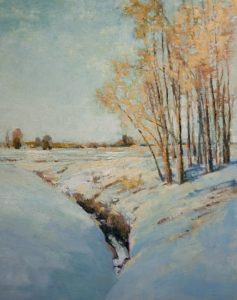
 A lot of thought and exploration goes into developing a series of paintings for an art exhibition.
Today, this has been a topic of conversation between my good friend and fellow artist, Shanna Kunz and me. This weekend, Shanna and I are exhibiting together in an all women art show, “8 Broad Brush Stokes”. (Come see us in Utah, November 16-17).
Shanna and I love to talk ‘shop’ when we are together. Today, we have been discussing the importance of producing a cohesive body of paintings for each of our upcoming winter exhibitions.
I was really impressed with Shanna’s clear 10 step approach to developing a series of exhibition paintings. Shanna is a landscape painter, but these steps could be applied toward any painting subject.
One
The first step is to decided upon a theme.
For example: For a landscape painter, the theme might be a regional location, or a season, or you might choose to focus on abstraction, or paint quality.
Two
Next, it is important to plan the shape and sizes of your paintings. There is an emotional connotation attached to different formats.
- Horizontal = peaceful
- Vertical = majestic, active
- Square = risky, contemporary
- Standard = traditional
Three
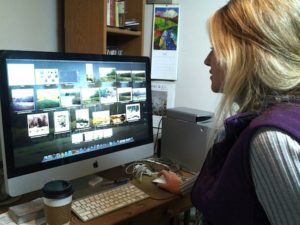
Choose subject matter from images and/or sketches that ‘speak’ to you. Shanna likes to use her computer to set-up miniature thumbnail landscape images to help her choose her reference material.
Four
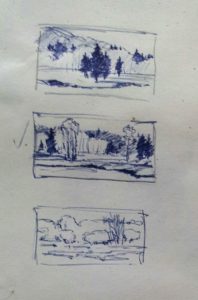
The next step is to create value thumbnail sketches. Simplify the composition into 4-5 values, paying special attention to patterns and spatial relationships. Be aware how the view enters a painting.
 Five
Five
Once the composition is chosen, it is time to choose the palette combination.
Six
Now that the palette of colors is chosen, the next step is to decide upon how to ‘key’ the painting. Will the painting be a high-key painting that is primarily lighter values, or mid range, or low-key with darker values? These are important decisions to consider.
Seven
What message are you trying to convey to the viewer? What is your focal point? It might be a single tree, a shape, or even a color. But, everything else will be subordinate to this focal point.
Eight
Once the painting is completed, put it away. Turn it to the wall for a few days. Then, reevaluate the painting, tweak it and make the necessary changes.
Nine
Framing is next. The frame is a continuation of the painting and the message. It is important to compliment the painting without distracting from it. The whole series of paintings should be framed consistently with small variations.
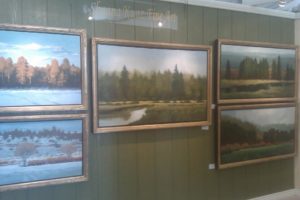
Ten
Lastly, once the whole series of paintings is framed, double-check and look at the series of paintings as a whole. Make sure you are happy with the group before your exhibition!
Good luck!
PS. Do YOU ever work in a series? Do YOU have any tips to add to this post? Please add your comments…
*****
Let’s meet on Twitter, and on Google Plus, Pinterest, and join in the fun at Fine Art Tips Facebook Fan Page! Please checkout my art too LoriMcNee.com, or find me on Instagram lorimcneeartist

I’ve been working with the moon and the monarch butterfly lately. My approach is to start all the paintings at the same time, reference and sketches in hand, and see where it goes. I find what I learn in every painting ripples across to the next ones.
Hello Katana, yes it is amazing how those creative juices get flowing once we get going!
Cheers,
Lori
I am preparing artwork for a show in the future and have created a website so that I may direct prospective galleries to take a look. If anyone has suggestions–ways to improve it, what to add, and so forth–please let me know.
Thanks a million.
Chuck
http://ChuckStaley.com
Thanks, Lori.
I work primarily in a thematic series. Call me a “serial artist” 😉
While each piece is interconnected to tell a much larger, more complex tale I feel it’s important that each work can also stand on its own to communicate its own individual message. I also tho k it’s important to involve the viewer in my work. I’m always asking myself “what am I trying to get OUT of the work and what am I trying to communicate THROUGH the work.” I hope this helps.
Hope this helps! You can view my series work on my website and see the latest for #MobWives Toni Marie Ricci on twitter @mbellart
Hello Michael,
Yes, your input does help! Great addition to the post. I know you from Twitter and it is fun to see you here. I am working on a series for my March show right now, and I am really enjoying the process.
Thanks for stopping by,
Lori 🙂
Thank you Lori and Shanna for the great article! I really like the ten steps and will apply them for my next paintings.
I have one question regarding the shapes – I would like to have series with paintings of different sizes and shapes. Do you think that is fine or should a series of paintings be for any reason just one shape?
Hello Radka,
That is a valid question. There of course are no hard ‘rules’ to this, and a lot has to do with your personal taste, gallery space and pocket book. I have seen many shows where artists focus on one shape, like squares. That can be very cool, but I think it is practical to mix it up for possible collectors.
Hope that helps!
Lori 🙂
Thank you Lori for your answer! 🙂
You are welcome!
Thanks for this great work flow. I am always challenged to make a fourth piece similar to the first three….etc. however, I am looking forward to my show opening on Dec. 6. And do believe it will be a cohesive work. Thanks, again!
Good luck with you show! Thanks for stopping by.
Lori 🙂
Great article. I am a glass artist but still benefit from your tips. Would you happen to have a similar article targeting non-painters?
Hello Dafne,
No I don’t have one for non-painters, but I can ask a friend to help! I will get back to you on this.
🙂
I have decided to focus on a theme this year. My goal is to get ten paintings done of birds in their natural habitat. I work primarily in acrylics. Do you think doing some transparently on paper (framed under mat and plexiglass) combined with some done in an opaque format (framed without glass or plexiglass) would be okay? I am thinking if the exterior frame is similar for both styles, it might work. What do you think?
Hello Jean, my apologies for the belated reply to your comment. I think your idea sounds wonderful and I hope you have been working on it. I’d love to see what you have come up with!
You two rock!
I’m printing this out and using for my next show. I think it’ll help me focus and be more organized.
Thanks
Romona! So fun to see you here. I am so waaay behind on my blog comments, so thanks for your patience. We had a lot of fun putting this post together. Hope we three can paint with each other soon. 🙂
Hi all- I am an A.P.(advanced placement) Art teacher in NY. The College Board requires students to create a “concentration” or a series of 12 works. I think the reason for this is to prepare students to be exhibiting artists. However, they always seem to get stuck on ideas. What advice do you have for high school students?
Hello Lisa, thanks for visiting my blog. I really enjoy working with high school students and other young people. Usually, they have a fresh approach and I learn so much from them! However, yes they can get stuck too. Here are two posts that might help your students. Let me know if you need anything else. ~Lori 🙂
https://www.finearttips.com/2010/08/10-ways-to-overcome-mental-blocks-boost-creativity/ https://www.finearttips.com/2010/11/5-unique-ways-to-brainstorm-out-of-a-creative-rut/
You have a wonderful way of making things easy and sensible too …
I never fail to learn something new or understand something I have been doing all along without knowing it !
However I am the type of artist that does not know to begin with what exactly it will look like in the end !
If I decide to do a piece in red and green …it may very well come out in yellow and purple
and in the past I have repainted it with my intention well in mind to paint red and green …4 hours later it is still yellow and purple …I have finally learned to let go and let it be …Who I am to judge anyways LOL
Thank you for taking time to comment and share you experience. Yes, sometimes our artwork has a mind of its own. Planning ahead with an organized palette, sketches, concept and a vision will help you grab ahold of your original thought and execute it. Other times, it is fun to see where the inspiration takes you! 🙂
This is great information Lori, thanks! As primarily a designer and illustrator over the years, I’m sort of a newbie in the fine art arena. I’m hoping to get more involved that way. A lot to learn and consider.
This post will help you look like a pro! Funny, I wasn’t ever taught this in college or in my galleries. This was on the job training!
Hi Lori:
Thanks for all your tips. I am about to have my first ever art exhibition. I do Indian traditional art. I work on specific three themes and have two standard sizes. I will be exhibiting around 40 piece. But to frame them I collected different styles of frames, it is ok to present different styles of frame? How to take their pictures for the poster? Should the pictures be take once framed or before?
thanks,
Lalima
Hello Lalima, congratulations on your upcoming exhibition. I would suggest taking the photos before framing. Also, try to hang groupings of similarly framed paintings. That will help the show look cohesive. I hope this helps!
Lori,
Are there strategies I might follow in offering prints of my photography regarding signed, numbered series, etc? Also any ideas about reducing costs of framing prints for showing and sales as framing not only get pricey but I feel sometimes it might be best done by the buyer for their specific situation.
Best Regards, Michael
Hello Michael,
You might want to check out this site, http://fineartamerica.com/. I use them to sell art prints of my paintings. They do a great job, and you don’t have to do any shipping. They handle it all. You can set your own print prices, etc. Check this out and let me know what you think. 🙂
Thanks so much for your quick response. I am actually going to sign up with FineArtAmerica. To expand a bit I am going to have a local showing of my work. I’d like to consider a limited numbered series. When artists do that does that mean the work has not been/will not be sold in another way? Similarly, what about signed works? Are they just considered more valuable because they are signed as opposed to unsigned?
Thanks again. I’m a fan of yours Lori. I’ll be following you on Twitter soon.
Michael
Thanks so much for your quick response. I am actually going to sign up with FineArtAmerica. To expand a bit I am going to have a local showing of my work. I’d like to consider a limited numbered series. When artists do that does that mean the work has not been/will not be sold in another way? Similarly, what about signed works? Are they just considered more valuable because they are signed as opposed to unsigned?
Thanks again. I’m a fan of yours Lori. I’ll be following you on Twitter soon.
Michael
I have worked in series for years. I paint the seasons, winter , spring ,summer and fall.
I find that I don’t get blocked about subjects to explore in paint , by working in series.
If artist Peter Dreher can paint the same glass of water hundreds of times, I too can paint I series.